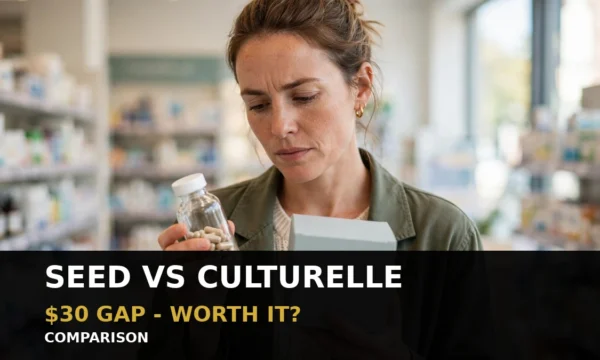
You are standing in the pharmacy aisle, Culturelle in one hand, your phone in the other. The box costs about twenty dollars and has sat here for years. Your phone shows Seed DS-01 at fifty dollars a month, in a glass jar, praised online. Both cannot be the right buy, and if that pause feels familiar, you are not alone in this.
This seed vs culturelle comparison is written for that pause: what is in each capsule, what the evidence supports, what each costs per day, and who should buy which.
Seed vs Culturelle: The Short Answer
In seed vs culturelle terms, the gap is not good product versus bad one. It is two ideas. Culturelle bets everything on one strain, Lactobacillus rhamnosus GG, studied for decades. Seed spreads its bet across 24 strains plus a prebiotic, at about two and a half times the price. For a specific job, Culturelle wins; for the broadest formula, Seed is the premium pick.
Five differences decide it:
- Strains: one in Culturelle, 24 in Seed.
- Live count: 10 billion CFU vs 53.6 billion AFU (different units).
- Evidence: one strain, decades of trials, against one finished-formula trial.
- Price: about $0.70 a day against about $1.67 a day.
- Buying: pharmacy shelf, one bottle, against a Seed subscription.
Seed vs Culturelle on Price: $1.67 a Day Against $0.70
The seed vs culturelle price question is a habit question: a price you resent is a habit you will drop. Seed DS-01 costs $49.99 a month on subscription, about $1.67 a day, about $600 a year; a three-month supply drops it to roughly $45 a month. Culturelle Daily Health runs about $18 to $22 for 30 capsules, about $0.60 to $0.75 a day. Prices checked November 2026; treat them as a range, not a promise.
Over a year, Seed costs roughly $330 to $380 more than Culturelle. That gap buys breadth, not a guarantee. Our Cymbiotika vs AG1 comparison asks the same value question at $79 a month: pay the premium only when you can name what it buys. Here it buys 23 more strains, a prebiotic, and a capsule built to survive stomach acid.
That is the seed vs culturelle buying split: one bottle, one decision, against a subscription you manage. Culturelle is a shelf buy: one bottle, no account. Seed sells mainly through its own site, first in a glass jar, then as refills. For a first try, the one-off bottle is lower-risk.
One Strain Against Twenty-Four: Inside Each Capsule
Culturelle Daily Health is one strain, LGG, at 10 billion CFU, plus 200 mg of inulin, a prebiotic fibre. LGG has been studied since the 1980s; it is now usually written as Lacticaseibacillus rhamnosus GG. Culturelle guarantees its CFU count through the expiration date, which matters because live cultures decline. It is shelf-stable, vegetarian, gluten-free and non-GMO.
Seed DS-01 is a synbiotic: probiotics plus a prebiotic in one product. Its 24 strains span 12 species and total 53.6 billion AFU, grouped into four blends: digestive health 38.7 billion, micronutrient synthesis 7.32 billion, cardiovascular 4.21 billion, dermatological 3.34 billion. The prebiotic is a pomegranate compound in the outer capsule; inside sits a smaller capsule of strains, a nested ViaCap design that aims to carry more bacteria past stomach acid. Seed is shelf-stable too.
That is the first real fork in the seed vs culturelle road. Culturelle’s narrowness is its strength: one strain, one dose, trials traceable to that exact strain. Seed’s breadth is its selling point and its honest limit: most of its 24 strains are present in small amounts, and the blend’s evidence rests on fewer trials than LGG’s. More strains is not automatically better: the NIH Office of Dietary Supplements says a higher count alone does not mean greater benefits; effects are strain-specific.
What the Evidence Says in Seed vs Culturelle
The seed vs culturelle evidence split is lopsided. Culturelle’s strain has the deeper record. A 2012 JAMA meta-analysis of 82 trials, 11,811 people, found probiotics cut the risk of antibiotic-associated diarrhoea by about 42% versus placebo, a relative risk of 0.58, with LGG carrying much of the positive data. That is the strongest claim either product can make, and it belongs to Culturelle’s strain, as our full Culturelle review explains.
Seed’s evidence is newer and narrower. A placebo-controlled trial of the finished DS-01 formula in 350 adults with bloating or indigestion was reported in early 2026 in Nutrients. Seed funded the trial; Radicle Science, an independent research organisation, ran it. The honest reading is modest: some improvement in bloating and regularity, not transformation. Our Culturelle vs Align comparison makes the same point: one trial is a beginning, not a verdict.
Neither product has proof for the biggest promises on its label: neither treats IBS, skin conditions or immune disease, and neither has strong trial evidence for immune boosting in healthy adults. If a claim matters, ask which strain was tested, at what dose, for that exact outcome. The NIH Office of Dietary Supplements probiotics fact sheet explains how strain-specific the evidence is, and the 2012 JAMA meta-analysis shows what the strongest pooled data looks like.
Who Each One Suits, and Who Should Skip Both
Buy Culturelle if you are starting antibiotics and want the best-evidenced cover for the diarrhoea that can follow, if you want the cheapest daily probiotic with a studied strain, or if you are a parent choosing a kids’ probiotic dosed for children.
Buy Seed if you want the broadest formula, you have already tried a single-strain probiotic without result, and $600 a year does not make you wince. Our Seed vs Garden of Life comparison covers the other big multi-strain choice at a lower price; our Jamieson vs Garden of Life comparison pairs two established vitamin brands.
Skip both if your gut is basically fine: fibre, fermented foods, sleep and stress matter more than any probiotic. If symptoms are persistent, painful or new, see a clinician instead. And if capsules are not your thing, our Vitafusion review looks at a gummy vitamin routine.
Safety, Side Effects and the Fine Print
On safety, seed vs culturelle is a level field: both are gentle for most healthy adults. The complaint nobody warns you about is a week or two of extra gas or bloating as your gut adjusts. Culturelle’s single strain tends to keep that milder, so start Seed when your week is calm.
Two rules matter. Take either one two hours apart from antibiotics, which kill live bacteria, helpful ones included. Check allergens: milk protein and soy appear in some Culturelle formulations; Seed is free of the 14 allergen classes listed by the European Food Safety Authority. The NIH warns probiotics can cause serious infections in the seriously ill or immunocompromised; if that is you, or you are pregnant or recovering from surgery, talk to a clinician first.
The Verdict
The seed vs culturelle verdict is not a winner and a loser; it is a question of what you are paying for. Culturelle gives you the best-evidenced strain in probiotics at about seventy cents a day, in a bottle you can buy once and forget. Seed gives you breadth, a prebiotic, a clever capsule and a finished-formula trial at about $1.67 a day. For most people, Culturelle is the smarter first buy.
If Culturelle does nothing after four to six weeks, you have spent about twenty dollars and learned something. If Seed does nothing, you have spent about a hundred. Ask that before you buy either side of seed vs culturelle, and let the answer, not the packaging, decide.
Questions People Actually Ask
In seed vs culturelle, which is better?
For most people, Culturelle: one deeply studied strain at about $0.70 a day, best proven for antibiotic-related stomach upset. Seed is the better pick only if you want a broad 24-strain formula with a prebiotic and the price does not bother you.
Is seed vs culturelle worth the price gap?
The gap is about $1 a day, or $330 to $380 a year. It buys 23 more strains, a prebiotic and an acid-resistant capsule. It does not buy a stronger evidence base: LGG’s trial record is deeper than DS-01’s one finished-formula trial. Pay it only for breadth.
How long should I try seed vs culturelle before judging it?
Give either product four to six weeks of daily use; gut habits change slowly, and a three-day trial tells you nothing. For antibiotic cover, start within two days of the first antibiotic dose and keep the two-hour gap.
Can I take Seed and Culturelle together?
No reason to combine them, and no trial has tested the pair. You would be paying for two products to do overlapping jobs. Pick one, judge it at six weeks, and only then consider switching.
Does Seed or Culturelle need refrigeration?
No, both are shelf-stable at room temperature. Store them cool and dry, check the date, and remember Culturelle guarantees its count through expiry.
Written by the HealthRovia editorial team. For general information only — not medical advice.