
It is six in the morning, the kitchen is still dark, and you have two tabs open on your phone. One shows a green powder that every podcast swears by. The other shows little glossy pouches that half your feed squeezes into smoothies. Both cost about $79 a month, and both promise better energy, better gut health, better everything. That moment is where the cymbiotika vs ag1 question usually starts. If it sounds familiar, you are not alone in this.
We did not take either product for 30 days, and we will not pretend otherwise. This is a label-and-evidence comparison — published labels, pricing math, testing claims, and what nutrition research actually says.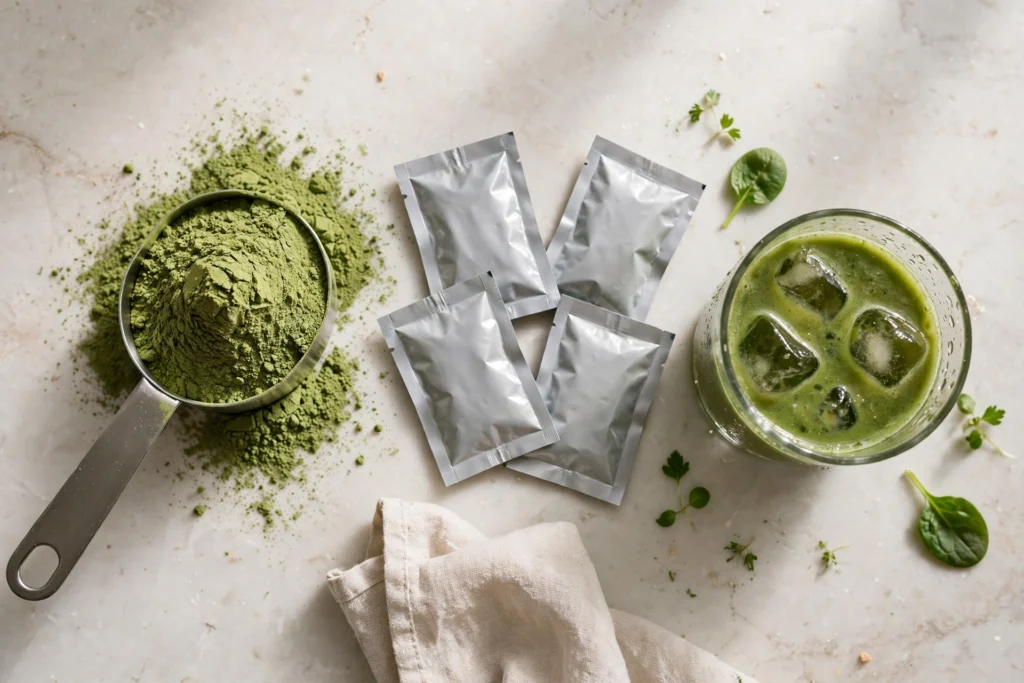
The short answer in the cymbiotika vs ag1 debate
If you only want the short version of cymbiotika vs ag1, here it is. AG1 is the better single daily habit, and Cymbiotika is the better targeted tool. One scoop of AG1 covers vitamins, minerals, greens, probiotics and adaptogens in a single drink. Cymbiotika sells single-purpose pouches, and its closest thing to AG1 — Super Greens gel — carries a fraction of the greens. Pick AG1 for one subscription that does the most; pick Cymbiotika for one formula.
First, they are not the same kind of product
AG1 is one product: a daily greens powder you mix with water. Cymbiotika is a range of more than 30 single-nutrient pouches — vitamin C, glutathione, magnesium, vitamin D3, creatine and a probiotic. The only direct overlap is Cymbiotika Super Greens gel against AG1 powder. See our full Cymbiotika review and our AG1 vs Bloom comparison.
7 honest facts before you pay $79
1. The only like-for-like fight is Super Greens vs AG1 — and the dose gap is enormous
AG1 packs its formula into a 12 to 13 gram scoop. Cymbiotika Super Greens contains about 452 mg of greens complex per pouch — under half a gram. The AG1 scoop carries roughly 25 times the greens by weight, and the gel has no probiotics, enzymes or fibre. This is the most lopsided number in cymbiotika vs ag1.
2. The price looks identical until you start stacking pouches
On headline price, the brands are twins: AG1 costs $79 a month on subscription, or $99 one-time. Cymbiotika Super Greens costs $78 one-time, or $54.60 on subscription. Stack vitamin D3, magnesium and glutathione — three boxes at $62 to $88 each — and the habit runs roughly $150 to $210 a month on subscription.
3. Cymbiotika tells you the dose. AG1 hides it.
This is the sharpest divide in cymbiotika vs ag1, and it cuts both ways. Cymbiotika discloses the dose of most ingredients on the label. AG1 lists more than 75 ingredients but groups most of them into proprietary blends, without saying how much of each botanical is inside. Its ashwagandha cannot be checked against the 300 to 600 mg doses used in trials.
4. Liposomal delivery is real science, not magic
A liposome is a microscopic sphere made of the same phospholipids that form your cell membranes, with the nutrient tucked inside. Cymbiotika cites a clinical study in which its vitamin D3 formula produced roughly twice the blood vitamin D of a standard one. But that is one formula, not proof for the whole range. The NIH notes that no form of vitamin C has been shown better than another in supplement form.
5. AG1 has the stronger published evidence
On evidence, cymbiotika vs ag1 splits in an interesting way. AG1 has published real trials on its finished product: a 2024 study of 30 healthy adults over four weeks, and a 2026 randomised trial in 20 trained adults that found two weeks of AG1 improved nutrient adequacy and enriched beneficial gut bacteria. Read the 2026 trial in Frontiers in Nutrition. Cymbiotika has no published product-level trial for most of its range, so AG1 is the more evidence-backed.
6. Taste decides whether you keep taking it
Taste decides cymbiotika vs ag1 more than any label ever will. AG1 has essentially one earthy, pineapple-and-vanilla flavour: some people like it, many tolerate it, nobody calls it delicious. Cymbiotika gels are sweet and syrupy, and reactions split by product — the creatine pouches draw the sharpest complaints about grainy sweetness.
7. The subscription is where both brands test your patience
Both brands are built to become a monthly bill. AG1 pushes you towards subscription with its pricing — $99 one-time against $79 a month — but softens it with a 90-day money-back guarantee on first orders. Cymbiotika offers a 60-day guarantee, and its Trustpilot score sits around 4.7 from more than 860 reviews. Yet buyers report renewals shipping without reminders and difficulty cancelling.
What cymbiotika vs ag1 really costs per day
The first surprise in cymbiotika vs ag1 is that the headline prices look identical while the yearly bills do not. A $79 habit is a $948-a-year habit, and a three-pouch Cymbiotika stack can pass $2,000 a year without you noticing. Prices checked November 2026.
| Option | Monthly | Per serving | Per year |
|---|---|---|---|
| AG1, subscription | $79 | $2.63 | ~$948 |
| AG1, one-time | $99 | $3.30 | ~$1,188 |
| Super Greens, subscription | $54.60 | $1.82 | ~$655 |
| Super Greens, one-time | $78 | $2.60 | ~$936 |
| Cymbiotika, 3-product stack | ~$150–$210 | ~$5–$7 a day | ~$1,800–$2,500 |
Per serving, Super Greens on subscription is the cheapest option here — but also the thinnest formula.
Third-party testing: who checks the work
AG1 is NSF Certified for Sport, which tests for banned substances, heavy metals and label accuracy. Cymbiotika says its products are third-party tested in GMP-compliant facilities and made in the USA. Neither brand publishes batch-level certificates for the public to inspect.
Who should pick which
So who actually wins cymbiotika vs ag1? Pick AG1 if you want one daily habit that covers the most ground, you train hard, or independent testing matters to you. Pick Cymbiotika if you travel constantly and hate mixing powders, or you want one specific formula such as glutathione or vitamin D3.
Pick neither if your budget is tight. A cheaper daily habit, like the brands in our Jamieson vs Garden of Life comparison, covers the basics for less. If gummies appeal more, our Vitafusion review looks at the friendliest option. For gut support, our Culturelle vs Align and Seed vs Culturelle comparisons look at dedicated probiotics.
The honest framing most comparisons skip
No powder or pouch replaces eating vegetables. Whole vegetables deliver fibre, water and a food matrix that no supplement replicates, and dietary guidance says to get most nutrients from food, with supplements filling gaps. A greens powder is a gap-filler for a bad week, not a substitute for a salad.
Safety fine print
Both brands are generally well tolerated, but natural does not mean side-effect-free. Expect possible mild bloating or gas when starting, usually settling within a week or two. Talk to your doctor first if you take blood thinners — greens powders are often rich in vitamin K. The same applies in pregnancy, with kidney disease, or on thyroid or blood pressure medication.
Our verdict
Our verdict on cymbiotika vs ag1 is simple. Buy AG1 if you want one daily habit, one subscription, and the strongest testing and trial record in this price bracket. Buy Cymbiotika if you want a specific formula in a pouch you can take anywhere, and you will pay the premium for that one thing. Buy neither because a creator smiled while squeezing a pouch.
Frequently asked questions
Is cymbiotika vs ag1 worth the money?
It depends on which one you mean. AG1 at $2.63 a serving is defensible if you value a comprehensive formula, published trials and NSF Certified for Sport testing. Cymbiotika is worth it for one specific formula with a plausible delivery story, like glutathione or vitamin D3, and much harder to justify for basic vitamin C or magnesium.
For gut health, which wins in cymbiotika vs ag1?
AG1, on the label. It carries a probiotic blend measured in billions of CFU per serving, plus prebiotics and digestive enzymes, while Cymbiotika Super Greens has no probiotics or enzymes at all. That is why, for gut support specifically, cymbiotika vs ag1 leans toward AG1. But Cymbiotika also sells a dedicated probiotic with 50 billion CFU across 19 species.
Can I take Cymbiotika and AG1 together?
There is no reason to take both. You would duplicate many of the same vitamins, greens and probiotics, pay twice for one job, and raise your odds of stomach upset.
Is Cymbiotika Super Greens the same thing as AG1?
No. Cymbiotika Super Greens is a 15 mL liposomal gel with about half a gram of greens per serving, while AG1 is a 12 to 13 gram powder with more than 75 ingredients, probiotics and enzymes.
Are there side effects?
Neither side of the cymbiotika vs ag1 comparison is free of side effects. The most common are mild gas, bloating or stomach upset when starting, usually fading within one to two weeks. People on blood thinners, and pregnant or breastfeeding women, should talk to a doctor first.
Written by the HealthRovia editorial team. For general information only — not medical advice.