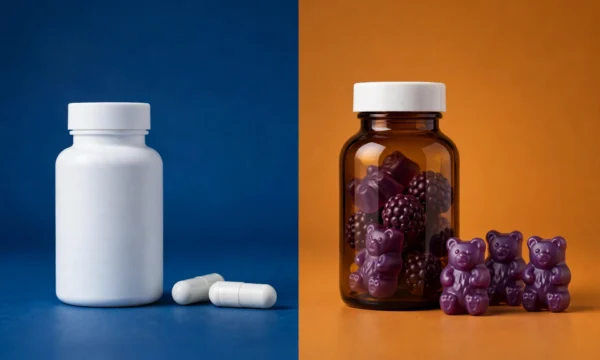
It’s 2 a.m. You’re propped up on one elbow, phone glow on your face, scrolling past two bottles that keep showing up in your feed: a white capsule bottle promising a neurologist-designed formula, and a purple gummy bottle promising a candy-like bedtime ritual. Relaxium Sleep vs Olly Sleep. If you’re reading this in the dark, exhausted and a little desperate, you’re not alone in this — and you deserve a comparison that isn’t an affiliate ad.
Our honest method, up front: we didn’t swallow either product for 30 nights, and we won’t pretend we did. This is a label-and-evidence comparison — the published Supplement Facts panels, per-night price math, third-party testing claims, and what peer-reviewed sleep research says about melatonin and these doses. No invented data, no fake reviewer credentials.
Quick verdict: who wins for whom
- Budget: Olly — roughly $0.60 a night vs. Relaxium’s ~$1.33.
- Biggest formula: Relaxium — 8 ingredients (magnesium, L-tryptophan, ashwagandha, GABA) vs. Olly’s melatonin-plus-botanicals gummy.
- Melatonin dose: Olly — 3 mg vs. Relaxium’s 5 mg; research studied far lower doses, and extra melatonin mostly buys morning grogginess.
- No added sugar: Relaxium — sugar-free capsules vs. candy-sweetened gummies.
- Safety simplicity: Olly — fewer ingredients, fewer interactions. Relaxium’s L-tryptophan is a genuine hazard alongside antidepressants.
- Trial evidence: nominally Relaxium (it ran one) — but with no objective gains and an FDA warning letter, call it a draw.
Relaxium Sleep is the heavily marketed, direct-to-consumer capsule built around a “triple-action” pitch: fall asleep faster, stay asleep longer, wake up refreshed. We already pulled it apart in our full Relaxium Sleep review — this short version matches its numbers exactly.
Two capsules deliver magnesium (100 mg), L-tryptophan (500 mg), a proprietary “Valerest” valerian-and-hops blend (228.9 mg, split undisclosed), ashwagandha (125 mg), GABA (100 mg), chamomile (75 mg), passionflower (75 mg), and melatonin (5 mg). The 5 mg of melatonin sits well above what sleep research uses, while the valerian dose sits well below it — valerian trials typically used 300–600 mg of extract, and the entire valerian-plus-hops blend here is only 228.9 mg with the split hidden.
The flagship trial found improvements only on subjective questionnaires; wearable trackers showed no objective gains. It later drew an April 2025 FDA warning letter over data-integrity concerns, a 2022 class action over “clinically proven” marketing was settled, and a 2023 California court ordered a $925,000 judgment over alleged auto-renewal violations. None of that is in the TV ads. If you’re weighing other hyped supplements, our AG1 review runs the same claim-pressure-testing playbook.
Olly Sleep: the mass-market gummy
Olly Sleep is the gummy at every Target and pharmacy: blackberry-flavored, easy to take, aimed at the casual sleepless — the person who wants a simple ritual, not a research project. We break the full label down in our Olly Sleep review; per 2-gummy serving the essentials are L-theanine (100 mg), melatonin (3 mg), chamomile (17 mg), passionflower (17 mg), and lemon balm (16 mg).
The honest arithmetic: 100 mg of L-theanine is a quarter to a half of what most sleep-stress trials used, and the three botanicals at 17, 17, and 16 mg are decoration around a 3 mg melatonin core — chamomile research, for comparison, studied doses around 400–800 mg. Functionally, a tasty low-dose melatonin gummy with a small calming bonus.
Advantages: the Regular Strength gummy is third-party tested (rare at this price), and 3 mg is a more moderate melatonin dose. Drawbacks: added sugar (glucose syrup, beet sugar), and gelatin — so it’s not vegan or vegetarian.
Side-by-side comparison
| Relaxium Sleep | Olly Sleep (Regular) | |
|---|---|---|
| Format | 2 capsules | 2 gummies (Blackberry Zen) |
| Melatonin | 5 mg | 3 mg |
| Other key ingredients | Magnesium 100 mg, L-tryptophan 500 mg, ashwagandha 125 mg, GABA 100 mg, chamomile 75 mg, passionflower 75 mg, proprietary valerian-hops blend 228.9 mg | L-theanine 100 mg, chamomile 17 mg, passionflower 17 mg, lemon balm 16 mg |
| Added sugar | None (capsule) | Yes (glucose syrup, beet sugar) |
| Third-party tested | Not advertised | Yes (Regular Strength only) |
| Own clinical trial | Yes — subjective gains only, no objective improvement, later FDA-flagged | No |
| Bottle price (approx.) | ~$39.95 (60 caps) | ~$14–$16 (50 gummies) |
| Cost per night | ~$1.33 | ~$0.56–$0.64 |
| Cost per year | ~$485 | ~$205–$235 |
Price-per-night: the math nobody shows you
Prices are approximate public figures as of 2026 — they change often. A direct Relaxium bottle runs about $39.95 for 60 capsules. At 2 capsules a serving, that’s 30 nights: $1.33 per night, roughly $485 a year of nightly use.
Olly runs about $14–$16 for 50 gummies. At 2 a serving, that’s 25 nights: ~$0.60 per night, about $205–$235 a year. Relaxium’s premium pays for five extra ingredients, not stronger evidence. Olly’s discount buys a simpler, tested product with fewer interactions. Neither buys proof of better sleep.
The melatonin dose honesty nobody gives you
Both products lean on melatonin — 5 mg in Relaxium, 3 mg in Olly — and both sit above what sleep research typically studies. A 2005 meta-analysis of 17 melatonin trials found it shortened the time to fall asleep by about 4 minutes and added about 13 minutes of total sleep — modest effects. And dose research points one way: lower doses (often 0.5–1 mg in studies) perform comparably for sleep onset, while higher doses mostly add next-day grogginess, vivid dreams, and daytime sleepiness.
Read the doses with clear eyes: Olly’s 3 mg is the more moderate choice; Relaxium’s 5 mg mainly buys more morning fog. NCCIH notes melatonin appears relatively safe short-term, but its long-term safety has not been established — worth knowing before either becomes a nightly habit. Melatonin is a timing signal, not a sedative: if your problem is racing thoughts at midnight, neither dose fixes that.
What the competitors don’t tell you
Four gaps in the top-ranking comparisons — the things this article exists to cover:
1. Nobody does the per-night math. Affiliate reviews list bottle prices, making a $39.95 bottle and a $14 bottle look vaguely comparable. They’re not: Relaxium costs more than double per night — and sleep supplements are bought nightly, not once.
2. Nobody compares the melatonin doses honestly. One camp calls Relaxium’s 5 mg “effective” and moves on; another praises Olly’s 3 mg as “appropriate” and moves on. Neither says both sit above research-studied doses — or that more melatonin mostly means more morning fog, ruining the “wake up refreshed” promise both brands make.
3. Nobody maps formula size against interaction risk. Relaxium’s eight-ingredient blend is sold as sophistication, but 500 mg of L-tryptophan with antidepressants is a documented serotonin-toxicity risk, and ashwagandha carries liver and thyroid flags our full Relaxium Sleep review documents. Olly’s short label isn’t impressive — but clashes less with your medicine cabinet.
4. Nobody talks about the kids’ risk. Gummies look like candy, and a 2024 report estimated about 11,000 U.S. emergency department visits from 2019–2022 for unsupervised melatonin ingestion by children 5 and younger. If either product lives in your house, lock it up — not on the nightstand.
Who should pick which
Forget “which is better” — ask which fits you:
- Pick Olly Sleep if you want the cheapest, simplest entry point; you hate swallowing pills; you value third-party testing on a budget; or your sleep trouble is occasional and mild. Our Olly Sleep review walks through the full evidence.
- Pick Relaxium Sleep if you want a multi-ingredient formula (magnesium, tryptophan, GABA, ashwagandha) rather than a melatonin-led one; you avoid added sugar; and you take no antidepressants or interacting medications — with a doctor’s okay. Read our full Relaxium Sleep review before ordering, especially the billing history.
- Pick neither if you’re on antidepressants, sedatives, blood pressure, thyroid, or blood sugar medications; you’re pregnant or breastfeeding; or you’re buying for a child.
- Consider a targeted alternative if your real issue is a racing mind or low magnesium: a magnesium complex for sleep and muscle recovery is cheaper than either, with fewer interactions. For persistent insomnia, CBT-I through your doctor is still the highest-evidence answer — no bottle beats it long-term.
Safety fine print (read this before buying either)
The honest risks:
- Next-day grogginess: dose-dependent and real, especially at Relaxium’s 5 mg. Older adults and early drivers should be cautious with either.
- Serotonin syndrome (Relaxium): NCCIH warns L-tryptophan supplements may cause life-threatening serotonin toxicity with medicines affecting serotonin. Anyone on SSRIs, SNRIs, MAOIs, or tricyclics should not use Relaxium without direct medical supervision.
- Ashwagandha flags (Relaxium): rare but documented liver-injury reports, thyroid effects, and interactions with blood sugar, blood pressure, and sedative drugs. Stop two weeks before surgery; avoid in pregnancy.
- Kids and gummies (Olly): store locked away — melatonin gummies are candy-adjacent, and pediatric accidental ingestion sends thousands of kids to the ER yearly.
- Alcohol and sedatives: don’t combine either product with alcohol, prescription sleep drugs, or other melatonin products.
- Don’t stack them: taking both doubles your melatonin (up to 8 mg) and your grogginess, with no evidence of extra benefit.
Relaxium’s own trial reported drowsiness, headache, upset stomach, and nighttime waking as adverse events. Olly’s simplicity means fewer reported issues — but also fewer reasons to pay a premium.
Frequently asked questions
Which works better for falling asleep — Relaxium Sleep or Olly Sleep?
Neither has strong head-to-head evidence. Relaxium’s own trial showed only subjective questionnaire improvements — wearable trackers recorded no objective gains — and it was later flagged by the FDA. Olly is essentially a 3 mg melatonin gummy, and a 2005 meta-analysis found melatonin’s average benefit is about 4 minutes faster sleep onset and 13 minutes more total sleep.
Is the 5 mg melatonin in Relaxium Sleep too much?
It’s above the doses most sleep research studied. Lower doses (around 0.5–1 mg in studies) work about as well for sleep onset with less next-day grogginess; higher doses mainly add drowsiness, vivid dreams, and morning fog. Olly’s 3 mg is the more moderate of the two.
Can I take Relaxium Sleep and Olly Sleep together?
No — you’d stack up to 8 mg of melatonin plus duplicated botanicals, with no evidence of better sleep. If one isn’t helping, try a different strategy (like CBT-I), not two bottles.
Are Olly Sleep gummies safe for kids?
The adult gummies should never be given to children — and any melatonin gummies should be locked up, since they look and taste like candy. A 2024 report estimated about 11,000 U.S. emergency department visits from 2019–2022 for unsupervised melatonin ingestion by children aged 5 and younger.
Which is cheaper per night — Relaxium or Olly?
Olly, by a wide margin: about $0.60 a night vs. Relaxium’s roughly $1.33 — roughly $220 vs. $485 over a year of nightly use. The premium buys Relaxium’s longer ingredient list, not stronger proof.
Written by the HealthRovia editorial team. For general information only — not medical advice.