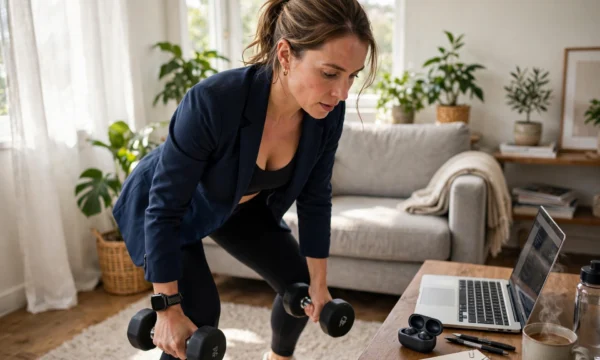
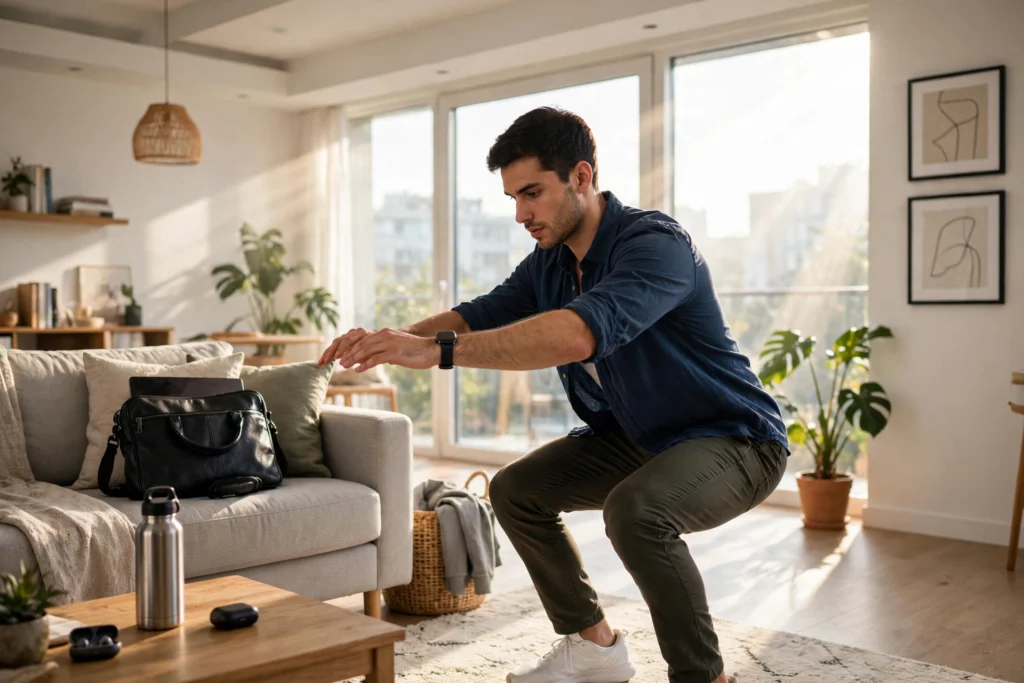
The CDC recommends that adults accumulate at least 150 minutes of moderate-intensity aerobic physical activity weekly, alongside muscle-strengthening activities on two or more days. Staying active and fit with a packed calendar is absolutely possible when you treat movement as a series of small, non-negotiable appointments rather than a single gym session.
Key Takeaways
- Accumulating brief 10-minute activity bouts provides cardiovascular benefits comparable to single continuous workouts.
- Non-Exercise Activity Thermogenesis (NEAT) accounts for significant daily caloric expenditure.
- Bodyweight circuits require zero equipment and can be performed anywhere in 15 to 20 minutes.
Active and Fit: Why 10-Minute Bouts Count
Research consistently shows that three 10-minute bouts of brisk walking deliver cardiovascular benefits comparable to one 30-minute session. The key is intensity: walk fast enough that talking requires slight effort, or climb stairs instead of waiting for the elevator. These micro-workouts also regulate blood sugar more effectively across the day than a single longer session, because each bout blunts the glucose spike from the nearest meal. For busy professionals, stacking short bouts before work, at lunch, and after dinner makes the 150-minute weekly target feel effortless.
Active and Fit: Boosting NEAT Throughout Your Day
Non-Exercise Activity Thermogenesis, the calories you burn through daily movement outside formal workouts, can vary by up to 800 calories between sedentary and active people. Simple upgrades compound fast: take walking meetings, park at the far end of the lot, do calf raises while brushing your teeth, or use a standing desk for calls. Fidgeting, gesturing, and taking the stairs all count. When you deliberately engineer more NEAT into your routine, staying active and fit stops depending on willpower and starts running on autopilot.
12 Practical Strategies to Stay Active and Fit
- Walk briskly for 10 minutes after each meal to aid digestion and control blood sugar.
- Do a 15-minute bodyweight circuit (squats, push-ups, lunges, planks) before your morning shower.
- Take the stairs for any climb under five floors, every single time.
- Schedule walking meetings for one-on-one calls instead of sitting.
- Keep resistance bands at your desk for 5-minute strength breaks between tasks.
- Park far away or get off transit one stop early to add steps automatically.
- Set an hourly timer to stand, stretch, and do 20 air squats.
- Do calf raises or wall sits while brushing your teeth or waiting for coffee.
- Try steady-state cardio twice a week with a brisk 30-minute walk or easy cycling session.
- Make weekends active by hiking, biking, or playing a sport instead of binge-watching.
- Track your steps and aim for a weekly average increase of 500 steps per day.
- Lay out workout clothes the night before to remove morning friction.
Bodyweight circuits are the ultimate busy-schedule workout because they need zero equipment and minimal space. A simple sequence of squats, push-ups, reverse lunges, and planks, performed for 40 seconds each with 20 seconds rest and repeated three times, delivers a full-body stimulus in under 20 minutes. Progress by adding rounds, slowing the tempo, or advancing to single-leg and incline variations. Two or three of these sessions weekly satisfy the muscle-strengthening guideline while building the strength that keeps joints healthy for decades.
Becoming the person who stays active and fit is less about motivation and more about design. Anchor movement to existing habits, track your streaks, and forgive the occasional missed day. Pair your activity routine with smart fueling from our complete guide to healthy eating, and explore zone 2 cardio to build an aerobic base that makes every other workout feel easier.
Even on your busiest days, a single 10-minute walk keeps the habit alive and your momentum intact.
If desk work is wrecking your alignment, our 8-week posture protocol fixes it step by step.
The Step Science: Why 7,500 Beats 10,000 for Most People
The 10,000-step target was born in a 1960s Japanese marketing campaign for a pedometer — not in a laboratory. So what does the science actually say? A 2022 meta-analysis in The Lancet Public Health pooled 15 international cohorts and found that mortality risk kept falling with more steps only up to a point: about 6,000 to 8,000 steps per day for adults 60 and older, and 8,000 to 10,000 for younger adults. People in the most active group, averaging around 10,900 steps, had roughly half the mortality risk of the least active group at 3,500 steps — but most of that benefit was already captured well below 10,000.
This is genuinely liberating news for a busy schedule. The research consistently shows that the biggest health gains come from the first few thousand steps — from escaping the sedentary zone under 4,000 — not from the last few thousand. If 10,000 feels impossible on a packed day, 7,500 is a perfectly respectable target backed by large-scale data. And for context on distance: with an average stride of about 2.5 feet, 10,000 steps covers roughly 4.7 to 5 miles, so 7,500 steps is a very manageable three-and-a-half miles spread across a whole day.
Pace Matters: Turn Your Walk Into Real Exercise
Volume is only half the story — cadence is the other half. A brisk pace above 100 steps per minute elevates walking into moderate-intensity exercise, delivering meaningfully greater cardiorespiratory benefits than the same number of steps taken slowly. You can estimate this without gadgets: at 100 steps per minute, you are moving fast enough that talking takes slight effort but singing would be impossible.
Try intervals to make your existing walks work harder: three minutes brisk, two minutes easy, repeated through the walk. This pattern raises your heart rate into the moderate zone without requiring extra time — the same 20-minute walk suddenly counts as genuine exercise rather than gentle movement. If counting steps per minute feels fiddly, use the talk test as your guide and simply pick up the pace until conversation takes mild effort. On the energy side, a 160-pound person burns roughly 400 to 500 calories walking 10,000 steps at a brisk pace (more with hills or stairs), and those calories compound: a consistent daily surplus of movement adds up to real body-composition change over months, even without dietary changes.
The Weekend Warrior Loophole: One or Two Sessions Can Be Enough
Here is the finding busy people most need to hear. A 2017 pooled analysis in JAMA Internal Medicine followed 63,591 adults and compared “weekend warriors” — people who got all their exercise in one or two sessions per week — against the regularly active and the inactive. The weekend warriors had a 30% lower risk of death from any cause and a 40% lower risk of cardiovascular death than inactive participants — nearly identical to the people who spread their activity across three or more weekly sessions.
The conclusion is straightforward: total weekly activity matters more than how you distribute it. If your weekdays are genuinely immovable, two focused sessions on Saturday and Sunday — a long hike, a bike ride, a full-body circuit — capture the large majority of exercise’s longevity benefit. Start conservatively if you have been inactive: build session length gradually over a few weeks, warm up thoroughly, and respect recovery, because jumping from zero to a heroic weekend can invite injury. Combined with the daily micro-movement habits above, the weekend warrior pattern is a legitimate, evidence-backed strategy — not a compromise.
Break Up Your Sitting: The Other Half of the Equation
Exercise sessions are only part of the picture; the other 15 waking hours matter too. The World Health Organization notes that higher amounts of sedentary behavior are associated with increased all-cause and cardiovascular mortality, independent of how much formal exercise you do. Researchers call the extreme version the “active couch potato”: someone who works out in the morning and then sits for ten unbroken hours — and the sitting still carries its own risk.
The fix is frequency, not intensity. Stand up and move for two to three minutes every hour: refill your water, take the stairs, do a lap of the office, or simply march in place during a long call. These micro-breaks blunt the blood sugar and blood pressure effects of prolonged sitting far better than one heroic stretch at day’s end. If you work at a desk, a standing desk for calls, walking meetings for one-on-ones, and a simple hourly timer turn an eight-hour sitting marathon into a day punctuated by dozens of tiny recoveries. Your body was not designed for chairs — it was designed for near-constant low-grade movement, and every interruption of sitting nudges you back toward that design.
References
- CDC. Physical Activity Guidelines for Americans. cdc.gov
- American College of Sports Medicine (ACSM). Exercise Guidelines. acsm.org
Frequently Asked Questions
Is 10,000 steps really necessary, or is a lower number fine?
Not necessarily. A 2022 meta-analysis of 15 international cohorts found that mortality benefits kept increasing only up to about 6,000-8,000 steps per day for adults over 60 and 8,000-10,000 for younger adults. The biggest health gains come from the first few thousand steps — escaping the sedentary zone under 4,000. If 10,000 feels out of reach, 7,500 is a well-supported target.
Does it still count if I can only exercise on weekends?
Yes. A 2017 pooled analysis of more than 63,000 adults found that ‘weekend warriors’ who did all their exercise in one or two weekly sessions had a 30% lower risk of death from any cause than inactive people — nearly identical to those who exercised three or more times per week. Total weekly activity matters more than how you spread it. Build up gradually if you have been inactive.
Does slow walking still help, or do I need to walk fast?
Yes, but pace adds benefit. Above about 100 steps per minute, walking becomes moderate-intensity exercise with greater cardiorespiratory effects than slow strolling. Try the talk test: walk fast enough that conversation takes slight effort. Intervals — three minutes brisk, two minutes easy — turn an ordinary walk into real exercise without adding time.