That Moment in the Mirror — and the Tub Everyone Recommends
You know that moment. You catch a new fine line in the mirror, or your knees complain on stairs that never used to bother you, and a quiet thought creeps in: is this just what getting older feels like now? If that sounds familiar, you are not alone in this. Millions of people are asking the same question, and many of them end up looking at the same product: Sports Research Collagen Peptides.
It is everywhere at once — in gym bags, in morning coffee routines, all over TikTok Shop. But popularity is not proof. This review looks at what it actually is, what it costs per gram rather than per tub, what the science really says, and where the honest downsides sit, so you can decide with clear eyes.
What It Is
Sports Research Collagen Peptides is an unflavored powder of hydrolyzed collagen, types I and III, from grass-fed bovine hide. “Hydrolyzed” means the collagen has been broken into smaller peptides, which is why it dissolves more easily than gelatin. It is a simple daily addition to drinks and food, not a flavored shake or a meal replacement. It is third-party tested, non-GMO, gluten-free, and marketed as keto- and paleo-friendly, with no added sugar in the plain version.
Get one thing straight early, because many reviews blur it: there are two different tubs. The plain version comes in a 16 oz (454g) tub. A separate 20 oz version adds vitamin C (100% of the daily value) and 120mg of hyaluronic acid. Their specs, prices, and serving counts are not interchangeable, so always check which tub you are actually looking at before comparing prices.
The Label, Decoded — and the Scoop Trap
For the plain 16 oz tub: one 11g scoop provides 11g of collagen peptides, 10g of protein, and about 40 calories, and the tub holds 41 servings. The maths checks out — 41 scoops at 11g is 451g, just under the 454g tub weight.
Here is the trap: a “scoop” and a “serving” sound interchangeable, but across brands they often are not. Some brands use a smaller scoop, some count a serving as two scoops, and some list collagen content lower than the scoop weight because of added ingredients. Sports Research is refreshingly straightforward here — one scoop equals one serving equals 11g of collagen — but never assume the same of a rival tub. Compare grams of collagen per serving, not scoops per tub.
A second plain truth: collagen is not a complete protein. It is low in tryptophan and lacks the full essential amino-acid profile, so it cannot replace a proper protein source. Think of it as a supplement to a balanced diet, not a substitute. For a strength and recovery contrast, creatine plays a completely different role, as our Nutricost creatine review explains from a performance angle.
Price Maths: What the Tub Really Costs
Most ranking reviews quote only the tub price and stop there. That misleads, because tubs differ in size, scoop weight, and collagen per scoop. The number that matters is cost per 10g of collagen — a standard amount that makes brands comparable.
At around $32.95 for the plain 16 oz tub with 41 servings, each scoop costs roughly $0.80, which works out to about $0.73 per 10g of collagen, according to a 2026 cost comparison. That is the figure to carry into any comparison: tub price divided by servings, adjusted for grams of collagen per serving. A cheaper-looking tub with a smaller scoop or fewer servings can quietly cost more per gram, and this maths exposes it. Our Sports Research vs Vital Proteins comparison runs that head-to-head in full, our Vital Proteins review covers the biggest rival on its own terms, and our NeoCell collagen review offers a capsule-format contrast.
One pricing wrinkle: prices differ by channel. On TikTok Shop, collagen peptides listings from the official SportsResearch shop have sold at around $22, against a list price near $32.95 elsewhere. Treat channel prices as moving targets — the per-10g maths is what keeps a bargain honest.
What the Evidence Really Shows — Including the Funding Caveat
Let us be direct: the evidence for collagen peptides is mixed, modest, and mostly about skin — not the sweeping transformations in advertisements. That is not a dismissal; it is the honest shape of the research.
On the encouraging side, a 2024 randomized controlled trial gave 85 women aged 43 to 65 either 5g of collagen peptides per day or a placebo for 84 days, and the collagen group showed improved dermis density and skin moisture (PubMed PMID 39143887). That is a real, peer-reviewed result, and it fits the most consistent signal in the wider literature: small-to-moderate skin benefits, particularly around hydration.
But here is the caveat most reviews skip. A 2025 meta-analysis pooling 23 randomized controlled trials with 1,474 people found that the apparent benefits disappeared in the non-industry-funded and high-quality subgroups (PubMed PMID 40324552). In plain language: when studies were company-funded or lower quality, collagen looked better; when funding was independent and quality higher, the effect faded. That does not prove collagen does nothing, but any review quoting only positive trials without this caveat is giving you half the story.
So collagen has reasonable, if modest, support for skin hydration and related measures. It is not proven for hair regrowth, joint repair, or muscle building, and no honest review should present it that way. Customer reports — including reviewers in an April 2026 NY Post shopping piece who praised joint comfort — are real experiences, not controlled evidence, and they cannot prove a product repaired a joint. Supplements also sit in a lightly regulated space, so the FDA’s own consumer guidance on dietary supplements (FDA: Dietary Supplements) is worth reading before treating any supplement claim as settled fact.
Taste and Mixing
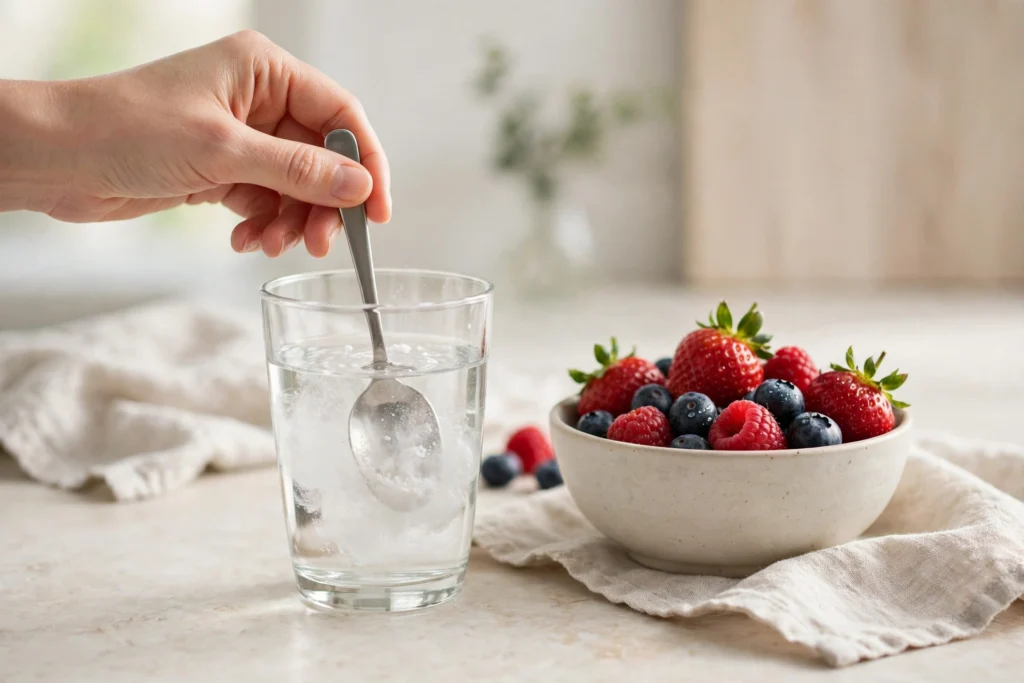
The plain version is neutral in hot drinks. It mixes best in hot coffee, tea, or smoothies, where heat and blending help it dissolve fully — stirred into morning coffee, it typically disappears without changing the taste. Cold water is a different story: it can clump and float unless shaken or blended vigorously. If cold drinks are your daily routine, expect extra effort, or stick to hot drinks and smoothies. Consistency matters more than timing: the trial showing skin effects used daily intake over 84 days, not occasional use, and any benefit is likely to be gradual rather than dramatic.
Complaints and Downsides
First, price per gram. At roughly $0.73 per 10g of collagen, Sports Research sits at the premium end, and budget brands can deliver similar grams for less. You are paying for a known brand, third-party testing, and a clean label — fair enough, but not the cheapest route.
Second, clumping in cold water — a minor but daily annoyance, and the most common practical complaint in customer feedback. Third, the incomplete-protein warning: anyone counting this powder as their daily protein intake is being shortchanged, and many glowing reviews omit this entirely. Fourth, version confusion: the plain 16 oz tub and the vitamin C plus hyaluronic acid 20 oz tub get mixed up constantly in listings, so check the exact label in your cart every time. Finally, expectations: bought for hair regrowth, joint repair, or muscle gains, it will disappoint, because the evidence does not support those hopes.
Who It Suits — and Who Should Skip It
It suits people who want a simple, unflavored, third-party-tested powder for a daily coffee or smoothie routine, who understand the evidence is modest and mostly skin-related, and who accept a premium price per gram. It also suits people who prefer powder over capsules, since a scoop delivers far more collagen per serving than a handful of pills typically does.
Skip it, or at least pause, if cost per gram matters most, if you mainly drink cold water and hate clumping, if you need a complete protein source, or if you are buying it for hair, joint, or muscle claims the evidence does not support. Anyone pregnant, breastfeeding, managing a medical condition, or taking medication should talk to a clinician before adding any supplement.
Verdict: Worth It in 2026?
Sports Research Collagen Peptides is a well-made, straightforward product: clean label, honest scoop-to-serving maths on the plain tub, third-party testing, and a genuinely neutral taste in hot drinks. Its popularity is real — the official SportsResearch shop on TikTok Shop has sold roughly 380,000+ units overall, with collagen peptides listings accounting for around 20,400 of those sales.
But the verdict has to be conditional. If you want a reputable brand and a simple daily routine, and you accept modest, skin-focused evidence with a real funding caveat, it is a reasonable buy. If you want the lowest cost per gram, or you are chasing hair, joint, or muscle claims, compare first using the per-10g maths above. Sports Research earns its reputation for quality; it does not earn the exaggerated claims sometimes attached to it. Buy it for what it is, not for what the loudest ads promise.
Frequently Asked Questions
How much collagen is in one scoop?
The plain 16 oz tub provides 11g of collagen peptides per 11g scoop, with 10g of protein and about 40 calories. One scoop equals one serving, and the tub holds 41 servings.
What is the difference between the 16 oz and 20 oz tubs?
The 16 oz tub is the plain version. The separate 20 oz version adds vitamin C (100% of the daily value) and 120mg of hyaluronic acid. Do not mix up their prices, serving counts, or ingredient lists.
Does collagen really work for skin?
The evidence is mixed but most supportive for skin. A 2024 trial in 85 women found improved dermis density and skin moisture after 84 days at 5g per day, but a 2025 meta-analysis of 23 trials found benefits disappeared in non-industry-funded and high-quality subgroups. Expect, at most, small-to-moderate skin support.
Is it a complete protein?
No. Collagen is low in tryptophan and lacks the full essential amino-acid profile. It should supplement, not replace, complete protein sources in your diet.
Why does it clump in cold water?
Hydrolyzed collagen dissolves best with heat or vigorous blending. In cold water it can clump and float unless shaken or blended well; hot coffee, tea, and smoothies mix smoothest.
Is Sports Research or Vital Proteins better value?
It depends on the per-10g maths, not the tub price. At around $32.95 for 41 servings of 11g, Sports Research is roughly $0.73 per 10g of collagen. Run the same calculation on any Vital Proteins tub — price divided by servings, adjusted for grams per serving — before deciding.
Written by the HealthRovia editorial team. For general information only — not medical advice.