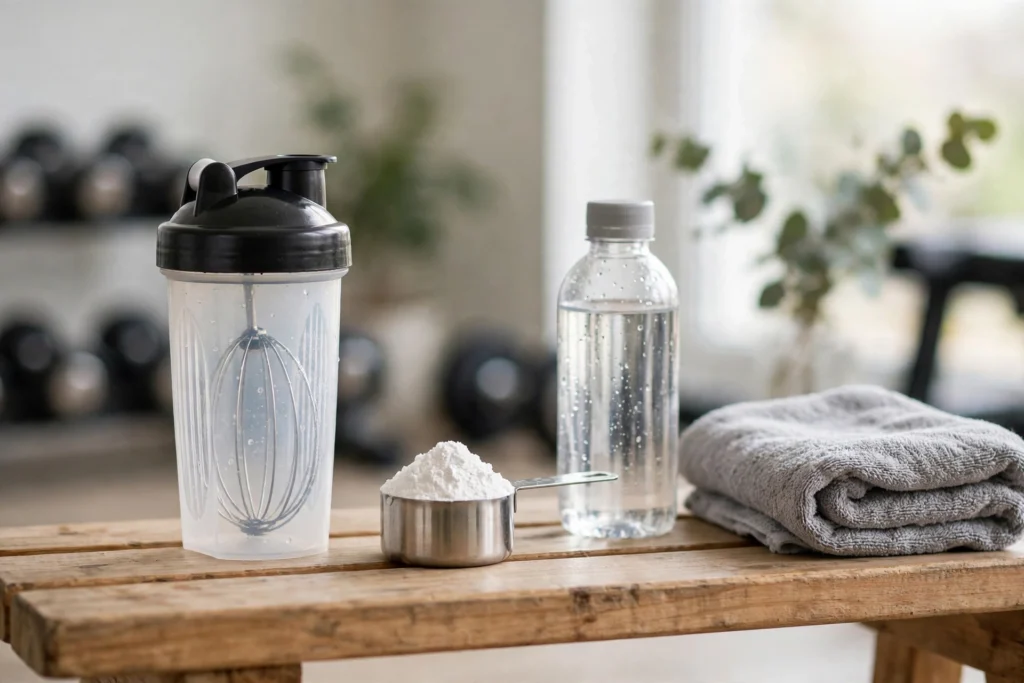
The tub that promises a lot for very little
You have probably been here before: staring at supplement tubs that all promise strength and results, while prices swing wildly from one shelf to the next. Some cost as much as a weekly shop; others look suspiciously cheap. And a very normal question follows: am I paying for quality, or just for a brand name?
If that sounds familiar, you are not alone in this. Plenty of lifters and ordinary gym-goers feel the same mix of hope and scepticism when they look at creatine. Nutricost Creatine Monohydrate sits right in the middle of that debate: cheap, everywhere on TikTok Shop, and raising one awkward question — can we actually see proof of what is inside? This review covers the label, price maths, evidence, and transparency gap, so you can decide with clear eyes.
What Nutricost Creatine Monohydrate actually is
Nutricost Micronized Creatine Monohydrate is a simple creatine powder: no fancy blend, no added stimulants, no long list of extras. Each scoop provides 5 grams of creatine monohydrate, and a scoop is included in the tub. It comes unflavored or in flavored versions.
That simplicity is a big part of its appeal. Creatine monohydrate is the form most studied in research, and Nutricost is not trying to reinvent it. It is also not a pre-workout, a protein powder, or a shortcut to muscle. Creatine can support training, but the training still has to happen.
The label and dose, decoded
The label is refreshingly short. One scoop gives you 5 grams of creatine monohydrate, the standard daily amount used in many research protocols, which makes the maths easy: one scoop, once a day, is the serving the tub is built around.
The tub sizes follow the same pattern: the 300-gram tub gives about 60 servings, the 500-gram tub about 100, and the 1-kilogram tub about 200. You are paying, gram for gram, for creatine monohydrate. Nutricost says it is made in a GMP-compliant facility in the United States, using globally sourced ingredients. GMP means Good Manufacturing Practice, standards for how supplements are made and handled. That is a baseline, not sport certification or a batch test certificate — a distinction we return to below.
The price maths: this is where Nutricost wins
In an October 20, 2026 comparison, the 500-gram Nutricost tub was priced at about $23.97. With 100 servings in that tub, that works out to about 24 cents per serving. That is genuinely hard to beat for plain creatine monohydrate.
Compare that with a premium rival like Momentous, at roughly 48 cents per serving on a comparable basis. Nutricost costs about half as much per serving. Transparent Labs also sits in that premium tier, with a higher per-serving cost, though its exact figure varies by size and sale price. Premium brands are not bad; you pay extra for named testing, certifications, and brand assurance, and you should know what that extra money buys. A similar price-per-gram habit helps elsewhere too, as our Sports Research vs Vital Proteins comparison shows.
What the evidence really shows
Creatine is one of the few supplements with a deep research base, and it helps to separate what is well supported from gym folklore. The National Institutes of Health Office of Dietary Supplements consumer fact sheet explains that creatine can increase strength and power for repeated short bursts of high-intensity activity, such as sprinting and weightlifting, while offering little value for endurance exercise. It helps you push harder in short, intense efforts; it does not replace training. You can read that fact sheet here: NIH Office of Dietary Supplements on exercise and athletic performance.
Typical research protocols use either a short loading phase followed by a smaller daily amount, or a steady daily amount without loading. Neither is a personal prescription, and this article is not telling you which one to follow. How much creatine suits you, and whether it suits you at all, is something to discuss with a qualified health professional, especially if you have a medical condition or take medication.
On side effects, the honest picture is fairly mild but not empty. Some people notice water retention or small weight gain; others report mild stomach discomfort, particularly at larger doses. Serious harms are not the usual story for healthy adults using standard amounts, but that is not a guarantee for any individual.
The transparency question: the gap other reviews skip
Here is where this review parts company with most ranking reviews. Many praise the price, mention the 5-gram scoop, and stop there. That is not enough: the most important question about a cheap supplement is not how much it costs, but how you know what you are getting.
Nutricost says its creatine is third-party tested by an accredited lab. That sounds reassuring, and it may well be true. But the brand does not clearly name the lab in a way shoppers can easily verify, and it does not show a certificate of analysis for the batch in your hand. There is no Creapure label, a trademarked German-made creatine with its own purity standards, and no sport certification, such as NSF Certified for Sport or Informed Sport, which test specifically for banned substances. None of that proves the product is impure. It proves something narrower, but still important: you are being asked to trust a claim you cannot easily check, while premium brands charge more partly because they give you that checkable proof.
Complaints and downsides, honestly covered
Some customers on TikTok report clumping, with powder forming hard blocks inside the tub. A small number also mention green spots in the powder. Those reports may reflect storage or handling conditions, such as moisture getting into the tub, rather than proven contamination, and they should not be presented as proof of contamination. Still, they are a reason to store the tub properly, keep it dry, keep the lid tightly closed, and stop using any powder that looks or smells off.
Keep this in proportion, too. Praise focuses on price and simplicity, and most users say the powder dissolves in water without trouble. At this sales volume, even a small percentage of unhappy buyers produces visible complaints. What is missing matters too: no sport certification, no named-lab certificate, no Creapure sourcing — the real cost of a budget price.
How popular is it, really?
On TikTok Shop, Nutricost’s official shop has sold approximately 967,000 units overall, and this creatine listing alone approximately 300,000 sales, rated about 4.6 stars from around 22,000 reviews. Treat those figures as approximate, since they vary slightly by count date.
Who it suits, and who should skip it
Nutricost suits the budget-conscious lifter who wants plain creatine monohydrate, understands the evidence, and accepts a testing claim without a named lab or public certificate. It suits someone training for strength or short, intense efforts, who will store the tub properly and values low daily cost over premium assurance.
It is a less good fit if you are a tested athlete: pick a sport-certified option instead, tested specifically for banned substances and carrying a certification you can verify. It is also weaker if you want batch-level proof of purity, if the clumping reports bother you, or if you prefer to pay more for a paper trail you can check. There is nothing wrong with paying for peace of mind. If creatine is one part of a wider recovery routine, compare like with like: our Sports Research collagen review looks at a recovery-stack product with a very different job, showing why price alone never tells the whole story. Our Canadian Protein review covers another budget-friendly brand competing on price, while our Momentous vs Thorne comparison looks at the premium end, where testing and certification are a much bigger part of what you pay for.
Verdict: cheap, simple, and honest about its limits
Nutricost is easy to recommend for what it is, and easy to criticise for what it is not. What it is: 5 grams of creatine monohydrate per scoop, in a simple tub, at about 24 cents a serving, with a large base of broadly happy customers. What it is not: a product with named-lab testing you can verify, a sport-certified option for tested athletes, or a premium brand with a published paper trail.
If price is your main concern and you are comfortable with that trade-off, this is a sensible, no-nonsense buy. If transparency and certification matter more than saving roughly 24 cents a serving against a premium rival, spend the extra money and buy the proof. Either choice is reasonable; the mistake is pretending there is no trade-off at all. Creatine supports short, intense training, it is not a treatment for any disease, and if you have health concerns, talk to a professional before starting any supplement. The U.S. Food and Drug Administration’s consumer guide is a useful starting point on how supplements are regulated: FDA consumer update on dietary supplements.
Frequently asked questions
Is Nutricost creatine good value?
On price per serving, yes. At about 24 cents a serving for the 500-gram tub, it costs roughly half as much per serving as premium rivals like Momentous. The trade-off is less verifiable testing proof, so value depends on whether price or transparency matters more to you.
How much creatine is in each scoop?
Each scoop provides 5 grams of creatine monohydrate, and a scoop is included in the tub. The 300-gram tub gives about 60 servings, the 500-gram tub about 100 servings, and the 1-kilogram tub about 200 servings.
Is Nutricost creatine third-party tested?
The brand claims third-party testing by an accredited lab, but it does not clearly name the lab or show a certificate for your batch. There is also no Creapure label and no sport certification. That transparency gap is the main weakness of an otherwise simple product.
Why does Nutricost creatine clump sometimes?
Some customers report clumping or hard blocks, and a small number mention green spots. This may reflect moisture or storage and handling rather than proven contamination. Keep the tub dry, close the lid tightly, and do not use powder that looks or smells off.
Is Nutricost creatine suitable for tested athletes?
Probably not the best choice. Without sport certification, a tested athlete cannot verify banned-substance testing to the same standard. A sport-certified creatine from a brand that publishes its certification is a safer pick in that situation.
Does creatine help endurance exercise?
Not much, according to the NIH Office of Dietary Supplements. Creatine is best supported for repeated short bursts of high-intensity activity, such as sprinting and weightlifting, and offers little value for endurance exercise.
Written by the HealthRovia editorial team. For general information only — not medical advice.