The Short Answer, Before We Get Into It
Astaxanthin is a red-orange antioxidant pigment made by a freshwater microalga called Haematococcus pluvialis — the reason salmon are pink and flamingos are flamboyant. It is one of the fastest-rising wellness searches in the world right now, at roughly 301,000 monthly searches and growing over 300% year over year. Human trials suggest it can modestly improve skin elasticity and moisture, nudge triglycerides down and HDL up, and that it is generally safe at the studied doses of 4 to 12 mg a day. It does not reliably lower LDL or blood pressure, it is not a substitute for sunscreen or statins, and the famous “6,000 times stronger than vitamin C” claim comes from a test tube, not from people.
Why Is Everyone Talking About It Right Now?
This is not a new discovery — scientists have studied astaxanthin for decades. What is new is the attention: skin-focused creators on TikTok and Instagram spent the last year calling it the “king of antioxidants,” a celebrity supplement collaboration went viral in early October, and beauty influencers are crediting red softgel capsules for glowier skin. When one ingredient gets that spotlight, the exaggerated claims follow. The rest of this article is the version with citations.
What Is Astaxanthin, in Plain English?
Astaxanthin (pronounced asta-ZAN-thin) is a carotenoid — the same broad family that gives carrots beta-carotene and tomatoes lycopene. The natural story: the freshwater microalga Haematococcus pluvialis makes it when stressed, krill and shrimp eat the algae, salmon eat the krill, and the pigment builds up the food chain. That is why wild salmon is deep orange-pink and why flamingos are flamboyant. Animals cannot make it; they have to eat it.
Two facts worth knowing: it is not vitamin A — your body can split beta-carotene into vitamin A but cannot do that with astaxanthin — and its unusual structure (polar groups at both ends, a long chain of double bonds in the middle) lets it stretch across a cell membrane and quench free radicals on both sides in lab tests. Real chemistry; whether it means real health benefits is exactly what human trials are for. A review of its sources and chemistry by Ranga Rao Ambati and colleagues is freely readable on the PubMed page for Ambati et al. 2014.
The “6,000 Times Stronger Than Vitamin C” Claim, Honestly Explained
This number sits on half the supplement labels in the store. It comes from a 2007 paper by Nishida, Yamashita, and Miki, who measured how well antioxidants neutralized one specific reactive molecule — singlet oxygen — in a test tube. On that single test, astaxanthin beat vitamin C by roughly 6,000 times.
Here is what the label leaves out. On a different free-radical test, the same comparison yields a gap of only about 65 times. The multiplier changes completely depending on which test you run, so it cannot predict what happens inside your body, where absorption, dose, and tissue distribution all matter. There is also a dose problem: adults need 75 to 90 mg of vitamin C a day, while astaxanthin capsules hold just 4 to 12 mg.
The claim is not a lie — it is a lab measurement doing marketing duty. Treat it as chemistry trivia, not a health outcome.
What Human Studies Actually Show
Animal and cell studies are abundant, but animals are not people. Below is the pooled human evidence, area by area — including the misses, which is how you tell an honest review from a sales page.
Skin: the strongest evidence
A 2021 systematic review and meta-analysis in Nutrients pooled 11 human studies (9 randomized trials of oral astaxanthin). Oral astaxanthin significantly restored skin moisture and improved elasticity versus placebo. Wrinkle depth did not significantly decrease. Caveats: trials were small and short, several tested branded products. Expect modest hydration and elasticity gains, not wrinkle erasure — and it is no substitute for sunscreen. The full meta-analysis by Zhou and colleagues is open access.
Cholesterol and triglycerides: modest, specific
Pooled randomized trials (8 trials, 307 people): triglycerides down, HDL up modestly, no meaningful effect on LDL or total cholesterol. In prediabetes/type 2 diabetes, one analysis found triglycerides down about 21 mg/dL and HDL up about 3 mg/dL — real but small. If high LDL is your concern, astaxanthin is not a substitute for statins or diet changes. If heart numbers are your main focus, start with Heart Health 101: 8 evidence-based steps to a healthier heart.
Blood pressure: mostly a miss
Often listed as a benefit; the evidence does not hold up. The largest pool (17 studies, 1,101 people, ~10 mg/day for ~2 months) found no significant effect on systolic or diastolic pressure. An earlier 10-trial analysis found only a borderline diastolic dip of ~1.2 mmHg at 12 mg or more. Unproven for blood pressure — never a swap for prescribed medication.
Brain, exercise, and eyes: early signals
A 2024 meta-analysis of 11 trials in 346 healthy adults found only a marginal effect on cognitive accuracy and no reaction-time change. More interesting: people taking astaxanthin while training regularly showed improved performance and fat oxidation, with lower post-exercise protein-oxidation markers — a lab marker, not proof you will run faster, but a legitimate research area. A handful of small, often industry-funded trials have looked at eye fatigue in heavy screen users: early evidence at best, worth watching.
How Much Is in Your Food vs a Capsule
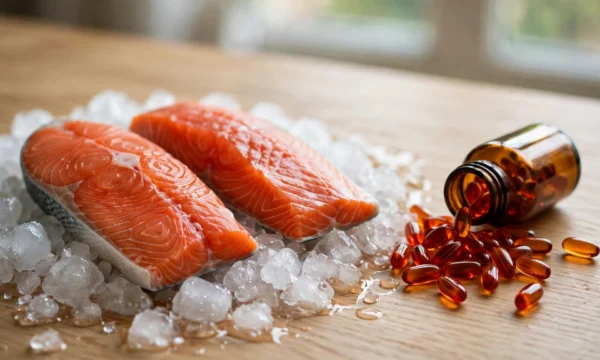
Can you just eat your way to supplement-level astaxanthin? It depends on the salmon. Wild sockeye contains roughly 26 to 38 mg per kilogram of flesh — about 2.6 to 3.8 mg per 3.5-ounce serving — so a typical 6-ounce fillet delivers roughly one 4 mg capsule’s worth. Farmed Atlantic salmon holds only about 6 to 8 mg per kilogram, under 1 mg per serving: you would need well over a pound a day to match a single 4 mg capsule. Shrimp, trout, and krill contain it too, in smaller amounts. Food gives you some; supplements give you the studied doses. For a broader look at antioxidant-rich eating, see our guide to 10 superfoods that boost your immune system naturally.
How Much to Take, and How to Take It
Most human trials use 4 to 12 mg per day, and most capsules sit in that range:
- General antioxidant support: 4 to 6 mg daily.
- Skin (elasticity, moisture): 6 to 12 mg daily — the range used in the skin trials.
- Exercise support: 4 to 8 mg daily in the training studies.
Two tips that matter more than the exact milligram: take it with a meal containing some fat (it is fat-soluble, so absorption is noticeably better), and give it time — skin trials ran for weeks before effects showed, blood-fat changes over months. Anyone promising overnight results is selling, not informing. Talk to your doctor first if you take prescription medication or have a chronic condition.
Natural vs Synthetic: How to Pick a Supplement
Not all astaxanthin is the same. “Natural” comes from the microalga Haematococcus pluvialis; synthetic is made from petrochemicals and is the form used in most farmed-fish feed. Lab studies suggest the natural form is the stronger antioxidant, but no large human trial has compared the two head-to-head, so do not pay a huge premium purely on that claim. A simple label checklist:
- The source names Haematococcus pluvialis — if no source is named, assume synthetic.
- The dose per capsule is stated in mg (4 or 6 mg capsules are standard; be wary of “proprietary blends” hiding the amount).
- A third-party testing seal (USP, NSF, or similar) — manufacturing quality varies enormously.
- No disease claims on the label (“cures,” “treats,” “prevents”) — legitimate companies do not promise those.
Side Effects, Interactions, and Who Should Skip It
Astaxanthin is generally well tolerated — human trials have not turned up serious safety signals at the studied doses. The honest list:
- Red or orange stool. The pigment colors things; it is harmless, but know it in advance so you do not panic. Know the difference, though: black, tarry stool or bright red blood can signal bleeding and needs prompt medical attention, supplement or not.
- Blood pressure and blood sugar effects. It may slightly lower both in some people. If you take medication for either, discuss it with your prescriber rather than stacking effects on your own.
- Pregnancy and breastfeeding. Safety here is simply unknown — not enough data, so the standard guidance is to skip supplements.
- Seafood and algae allergies. Algae-derived products are generally safer for seafood-allergy sufferers than krill- or shrimp-derived ones, but check the label and talk to your doctor if your allergy is serious.
- Hormone-related caution. Lab studies show it can inhibit 5-alpha reductase, the enzyme converting testosterone to DHT. Human evidence is limited, but if you take finasteride, dutasteride, or hormone therapy, ask your prescriber first.
Mild stomach upset at higher doses is occasionally reported and usually resolves by taking it with food and staying within the studied range.
The Bottom Line: Is It Worth It?
Astaxanthin is not a miracle, but it is not a scam either — which makes it more interesting than most trending supplements. The evidence supports modest benefits for skin hydration and elasticity, small triglyceride and HDL improvements, and a good safety record at 4 to 12 mg a day. It does not reliably lower LDL or blood pressure, the 6,000x vitamin C claim is lab trivia, and the wrinkle-erasing promises on social media run ahead of the data.
Consider it if you eat little seafood and want a supplement with actual human trials behind it; skip it if you are pregnant or nursing, take blood pressure or diabetes medication without your doctor’s input, or expect dramatic results. The basics — sleep, food, movement, sunscreen — still do far more for your skin and heart than any red capsule.
Frequently Asked Questions
What is astaxanthin?
Astaxanthin is a red-orange carotenoid antioxidant made by the microalga Haematococcus pluvialis — the pigment behind salmon’s pink color. Sold at 4 to 12 mg per day, it is studied mainly for skin, blood fats, and antioxidant effects. Your body cannot convert it into vitamin A.
Is astaxanthin safe to take every day?
At 4 to 12 mg a day, trials show a good safety record with mostly mild effects like reddish stool. Skip it in pregnancy and breastfeeding (not enough data); if you take blood pressure, diabetes, or hormone-related medication, check with your doctor first.
Does astaxanthin actually help skin?
A 2021 meta-analysis of 11 human studies found that oral astaxanthin improved skin moisture and elasticity compared with placebo, but did not significantly reduce wrinkle depth. Effects were modest, trials were small and short, and it is not a substitute for daily sunscreen.
Can astaxanthin replace vitamin C?
No. The “6,000 times stronger” figure comes from a 2007 test-tube measurement of one antioxidant reaction, not from the human body. Vitamin C has essential roles (like preventing scurvy) that astaxanthin cannot fill.
Can astaxanthin turn your stool red?
Yes — red or reddish stool is a known, harmless side effect of the pigment, more likely at higher doses. Black, tarry stool or bright-red blood is different and can signal bleeding; that needs prompt medical attention.
How much astaxanthin should I take?
Most trials use 4 to 12 mg daily: 4 to 6 mg for general support, 6 to 12 mg for skin, 4 to 8 mg around exercise. Take it with a meal containing some fat — it is fat-soluble and absorbs better that way.
Written by the HealthRovia editorial team. For general information only — not medical advice.