Last winter, a neighbour in Toronto texted me from the vitamin aisle: one hand holding the Jamieson probiotic her mother had bought for years, the other her phone, showing the green Seed bottle all over Instagram. “Which one do I actually buy?” she asked. If that sounds familiar, you’re not alone — that’s exactly where the jamieson vs seed debate starts.
The two brands could hardly be more different. Jamieson has sat on Canadian shelves since 1922; Seed is a California company selling one product, DS-01, only by subscription. One is the drugstore default, the other the internet favourite. This comparison grades them across seven points.
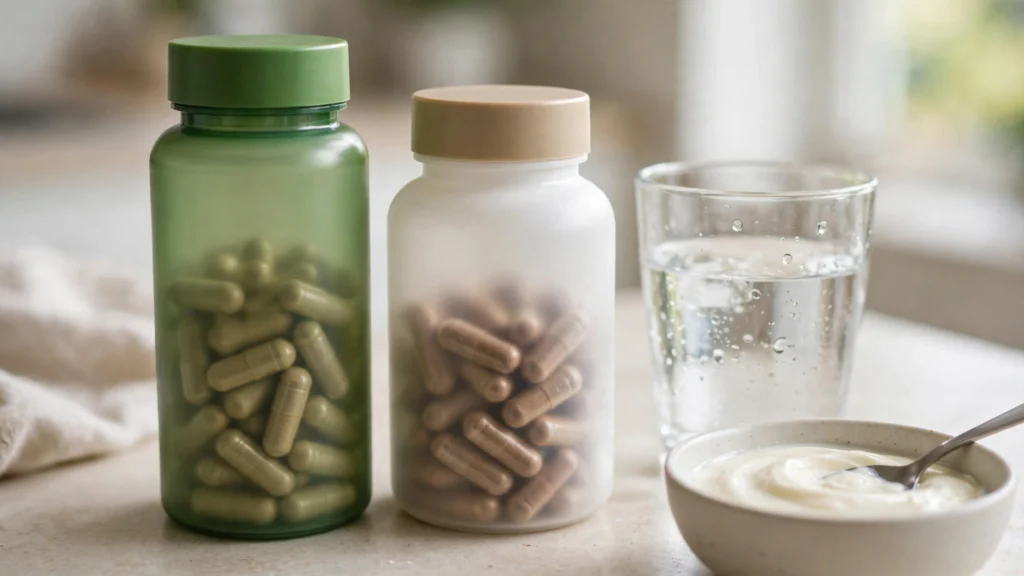
Jamieson vs Seed at a Glance: The 7-Point Scorecard
| Point | Jamieson 10 Billion | Seed DS-01 |
|---|---|---|
| Strains | 14 strains, CFU listed | 24 strains, blend totals |
| Potency | 10B CFU to expiry | 53.6B AFU to expiry |
| Clinical trials | None | 3 trials |
| Prebiotic | None | 400 mg pomegranate |
| Price per day | 0.58 CAD/day | 1.67 USD/day |
Point 1 — Strain Transparency: Who Shows You More?
Jamieson wins this point, and it isn’t close. Its label lists all 14 strains with the CFU of each one, from B. lactis UABla-12 at 2.0 billion to B. infantis at 0.01 billion. One caveat: that 0.01 billion is a token amount, and the top two strains carry 3.5 of the 10 billion between them.
Seed takes the opposite approach. When you read the jamieson vs seed labels side by side, Seed sorts its 24 strains into four blends, with a total count per blend, not per strain. The digestive blend holds 38.7 billion AFU across 16 strains, but no single strain’s share is shown. Seed wins on diversity, Jamieson on showing its work. Our Seed vs Garden of Life comparison puts the two side by side.
Point 2 — Potency: The AFU vs CFU Trap
Here is the number that fools almost everyone: 53.6 billion against 10 billion. It looks like Seed is five times stronger — but the two numbers use different units. Seed counts in AFU (Active Fluorescent Units), a count of intact cells; Jamieson counts in CFU (Colony Forming Units), cells that grow in a lab culture. A jamieson vs seed comparison has to start with units, not numbers.
The NIH Office of Dietary Supplements makes the same warning in plainer terms: higher CFU counts are not necessarily more effective, and what matters is live cells at the end of shelf life, not at manufacture. Both pass that test — Jamieson guarantees 10 billion active cells through expiry, and Seed guarantees full potency to the expiration date. Call this point a draw — and be suspicious of any review that declares a winner from the headline numbers.
Point 3 — Clinical Evidence: Trials of the Actual Product
This is Seed’s strongest point, and the one that justifies its price. Three randomized, placebo-controlled trials tested the complete DS-01 formula — not just its strains. The headline study, from 2026, followed 350 adults with everyday bloating for six weeks and found DS-01 beat placebo on bloating, gas and regularity. Few probiotics can say their retail formula was tested this way, and the jamieson vs seed evidence gap is the widest of the seven points.
Two honest caveats. First, all three DS-01 trials were funded by Seed, with company-affiliated authors, and the symptom results were modest and self-reported. Second, Jamieson has no published trial of its finished 10 Billion formula. Its strains, like L. acidophilus DDS-1, have individual study histories — but a strain study is not a product study. Seed takes this point clearly. For context, see our Jamieson vs Thorne comparison and our Ritual vs Thorne comparison.
Point 4 — The Prebiotic Difference
Seed is a synbiotic, not just a probiotic. Its outer capsule carries 400 mg of Indian pomegranate extract, a polyphenol prebiotic Seed calls MAPP, designed to feed gut microbes without gassy fermentation. Jamieson contains no prebiotic at all.
Does that matter? It depends on your plate. If you already eat plenty of plant foods and fermented foods, your gut microbes are fed anyway, and the prebiotic is a nice extra, not a deciding factor. For a jamieson vs seed shopper low on plants, though, the prebiotic edge is real. Seed takes the point.
Point 5 — Price Per Day: Drugstore vs Subscription
Now, the wallet part. Jamieson’s Probiotic 10 Billion lists at 34.99 CAD for 60 capsules — one capsule a day, about 0.58 CAD per day. You can pick it up at any Canadian drugstore, no account, no subscription. If budget is your first filter, our Kirkland review looks at another wallet-friendly option.
Seed costs 49.99 USD a month on subscription, two capsules a day — about 1.67 USD per day, roughly three times Jamieson’s daily cost. Canadians pay in US dollars, and Seed is sold only through seed.com, with no drugstore fallback. The 30-day guarantee covers the first order. On pure price, Jamieson wins by a wide margin, and the jamieson vs seed gap here is the biggest reason most Canadian shoppers start with Jamieson.
Point 6 — Daily Routine: One Capsule vs Two
A supplement only works if you take it. Jamieson is one capsule a day, with or without food, no refrigeration, bought whenever you run out. It fits a morning routine like a multivitamin — boring, and that’s a compliment.
Seed asks a little more: two capsules at once, no refrigeration either, but a monthly subscription you manage online, with a one-capsule ramp-up for three days. The subscription means you never run out — until you want to stop, which means logging in to cancel. That is the quiet jamieson vs seed difference: one fits a routine, the other manages it. Jamieson also offers women’s and children’s lines; Seed is adults 18 and over.
Point 7 — Safety: Who Should Skip Either One?
Both products are generally well tolerated. The most common complaint is mild gas or bloating in the first few days as your gut adjusts — usually short-lived. Neither treats any disease, and neither is a fix for a diagnosed gut condition.
Some people should talk to a clinician first: anyone with a weakened immune system, a serious illness, or who is pregnant. The jamieson vs seed safety picture is the same on both sides. The NIH notes probiotics should be used cautiously in these groups, and Seed advises the same for pregnancy and lactation. If that sounds like you, a five-minute chat with your doctor beats any comparison article.
Jamieson vs Seed: Which One Wins for You?
The seven points end in a split. Jamieson takes transparency, price and simplicity; Seed takes clinical evidence, prebiotics and strain diversity. Potency is a draw, because the headline numbers use different units. Neither brand is the “wrong” choice.
Choose Jamieson if your budget matters, you like buying off a shelf with no subscription, and you want a straightforward probiotic from a brand Canada has trusted for over a century. Choose Seed if you want the most-studied finished formula, you value the built-in prebiotic, and the price doesn’t make you wince. So which side of jamieson vs seed wins for you? Are you buying simplicity, or evidence? Answer honestly, and the right bottle picks itself. If Seed is pulling you in, our Cymbiotika vs Seed comparison puts it against another premium favourite, and our MaryRuth’s vs Bloom comparison covers two more brands dominating the same feeds.
Jamieson vs Seed: Frequently Asked Questions
Is Jamieson vs Seed a fair comparison for a first probiotic?
Yes — it shows both ends of the market in one place. Jamieson is the accessible drugstore standard and Seed is the premium subscription synbiotic. If you’re unsure, start with the cheaper one and judge by how you feel after four to six weeks.
Which is cheaper in the Jamieson vs Seed price math?
Jamieson, by a wide margin — about 0.58 CAD per day against Seed’s 1.67 USD per day on subscription, roughly three times as much, and Seed is subscription-only.
Can I take Jamieson and Seed together?
In a jamieson vs seed routine, there is no reason to take both. Doubling up on probiotics doesn’t double the benefit, and it makes it impossible to tell which product is doing what. Pick one, take it for four to six weeks, then decide.
Does Seed DS-01 need refrigeration?
No. Seed’s ViaCap capsule survives at room temperature, and Seed guarantees full potency through the expiration date. Jamieson is also shelf-stable, with potency guaranteed to expiry — so neither bottle needs fridge space.
Who should not take a probiotic without asking a doctor first?
Anyone with a weakened immune system, a serious illness, or who is pregnant should check with a clinician. The NIH advises caution for these groups, and Seed gives the same advice for pregnancy and lactation. Mild gas or bloating in the first days is common, but a doctor’s guidance matters more.
Written by the HealthRovia editorial team. For general information only — not medical advice.