If your neck aches by 3 p.m., your shoulders have migrated somewhere near your ears, and “sit up straight” lasts about ninety seconds before you melt back into your chair — you’re not broken. You’re untrained. Posture is not a moral failing or a willpower problem; it’s a strength and habit problem, and both are fixable.
Search for how to fix bad posture and page one is almost entirely videos — no written protocol with sets, reps, progression, or desk-setup numbers exists. This article is that protocol: at home, zero equipment (a resistance band helps in the final phase), about 12–15 minutes a day.
First: Figure Out What “Bad Posture” Means for You
“Bad posture” isn’t one thing. Most desk workers fall into one (or a mix) of three patterns. Knowing yours tells you what to prioritize:
- Forward head posture (“tech neck”): ears sit noticeably in front of the shoulders. Craning toward screens shortens the muscles at the back of the neck and weakens the deep neck flexors at the front.
- Rounded shoulders: chest muscles tighten while the muscles between the shoulder blades grow weak and overstretched. Shoulders roll inward, upper back rounds.
- Anterior pelvic tilt (“swayback”): sitting tightens the hip flexors while glutes and deep core go quiet, tipping the pelvis forward and over-arching the lower back.
The protocol below addresses all three at once — because in real bodies, they travel together. Per MedlinePlus (U.S. National Library of Medicine), the goal is straightforward: maintain your spine’s three natural curves (neck, mid-back, low back) without exaggerating them — head above shoulders, shoulders over hips.
The 60-Second Posture Self-Test
Do this now, before you start. You’ll repeat it every two weeks to track progress.
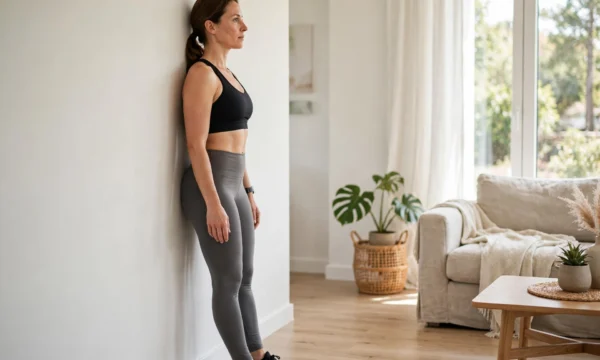
The wall test: Stand with your back against a flat wall, feet about six inches out from it. Touch the wall with the back of your head, your shoulder blades, and your glutes — all three, comfortably, without straining. Then check:
- Head: Can the back of your head touch the wall without tilting your chin up? If you have to crane back or it feels like a stretch, that’s forward head posture.
- Lower back: Slide one hand behind your lower back. A flat hand should fit, but not a fist. More space suggests excessive arching; no space at all suggests a flattened lower back.
The side-photo check: Have someone photograph you from the side while you stand naturally — don’t pose. Imagine a vertical line from your ear downward: in good alignment it passes through shoulder, hip, and ankle. If your ear sits well in front of your shoulder, that’s your baseline. Save the photo and retake it in eight weeks.
How to Fix Bad Posture: The 8-Week Protocol
The principle behind how to fix bad posture is simple: strengthen what’s weak, stretch what’s tight, and do it daily. Posture muscles respond to frequency more than intensity — 12 minutes every day beats one heroic hour on Sunday. Do this routine once daily, ideally at the same time so it becomes automatic.
Phase 1 — Weeks 1–2: Wake Everything Up
Your only job in phase 1 is consistency and learning the movements. Move slowly; never push through sharp pain.
- Chin tucks: 3 sets of 10. Sit or stand tall, draw your chin straight back (like making a double chin) without tilting the head. Hold 5 seconds per rep. Directly targets forward head posture.
- Doorway chest stretch: 3 × 30 seconds each side. Forearm on a doorframe, elbow at shoulder height, step through gently until you feel a stretch across the chest.
- Cat-cow: 2 sets of 10. On hands and knees, alternate slowly between arching and rounding the spine. Builds spinal awareness.
- Glute bridges: 3 sets of 12. On your back, knees bent, lift hips until knees-hips-shoulders form a line. Squeeze glutes 2 seconds at the top.
Phase 2 — Weeks 3–4: Add the Upper Back
Keep everything from phase 1, and add:
- Wall angels: 3 sets of 10. Back flat against a wall, arms in a “goalpost” position, slowly slide them up and down while keeping contact with the wall.
- Bird dog: 3 sets of 8 per side. On hands and knees, extend opposite arm and leg, hold 5 seconds, keeping hips level. Trains the deep core stabilizers.
- Prone Y-T-W raises: 3 sets of 8 each. Lie face down, arms in Y, T, then W shapes, lifting gently off the floor. Strengthens the mid-back.
- Progression: extend chin-tuck holds from 5 to 10 seconds.
Phase 3 — Weeks 5–8: Build Real Strength
Keep the phase 1–2 movements as your daily base (you can trim to 2 sets each now), and add loaded work three days per week. A single resistance band is enough.
- Banded rows: 3 sets of 12. Anchor a band at chest height, pull to your ribs, squeezing shoulder blades together. The single best movement for rounded shoulders.
- Single-leg glute bridges: 3 sets of 8 per side. Exposes and fixes left-right imbalances.
- Dead hangs: 3 × 20 seconds from a sturdy bar. Decompresses the spine and opens the chest — start with feet lightly touching the ground if a full hang is too much.
- Hip flexor stretch: 2 × 45 seconds per side, half-kneeling. Directly addresses the tight hip flexors behind anterior pelvic tilt.
Total time stays around 12–15 minutes. If a movement causes sharp or radiating pain, skip it — the “when to see a professional” section below applies.
Fix Your Desk: The Other 8 Hours
Exercises can’t out-train eight hours of bad sitting. Set up your workstation once, correctly, using these numbers:
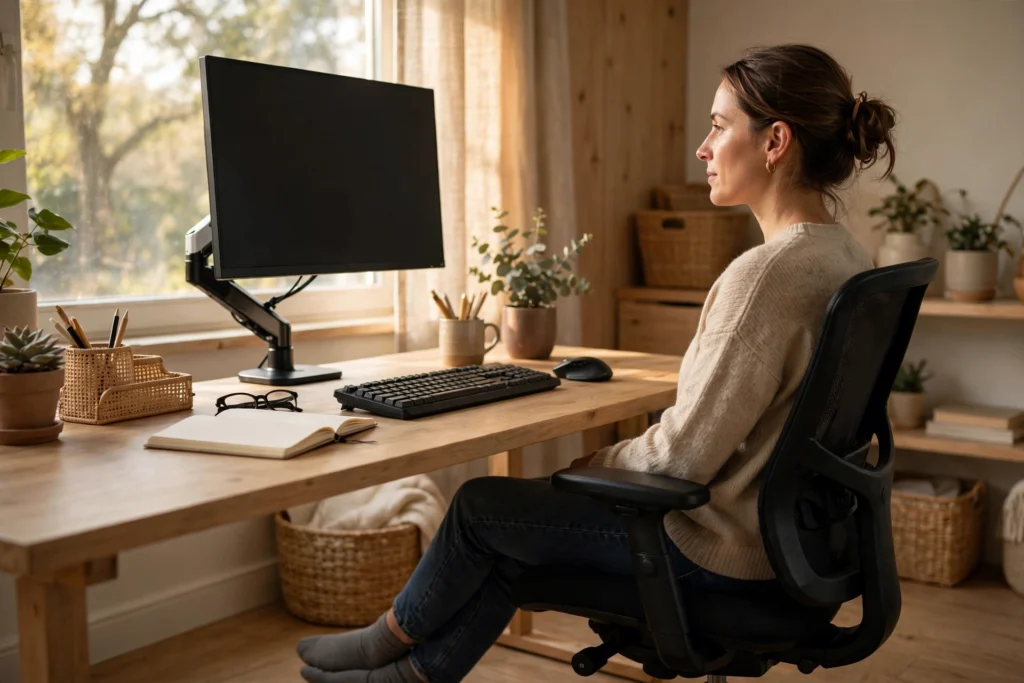
- Monitor: top of the screen at or just below eye level, about an arm’s length away (50–70 cm). This single change does more for forward head posture than any exercise. Laptop user? Raise it on a stand or books and use an external keyboard.
- Elbows: bent between 90 and 120 degrees, held close to your body — the exact range MedlinePlus recommends. Adjust chair height until this feels natural.
- Hips and knees: thighs parallel to the floor, feet flat on the floor (or a footrest), ankles slightly in front of the knees. Don’t cross your legs — it tilts the pelvis.
- Back: fully supported, with the chair’s lumbar support (or a rolled towel) filling the lower back’s natural curve.
- Shoulders: relaxed — not hunched toward your ears, not yanked back like a drill sergeant.
- Movement: stand and move every 30–60 minutes: a short walk, a stretch, anything. MedlinePlus advises switching positions often and stretching regularly to relieve muscle tension. Set a timer — willpower won’t remind you.
- Phone: hold it at eye level instead of bending your neck down to it. The cheapest fix in this article.
How Long Until You See Results? An Honest Timeline
Let’s set expectations honestly, because this is where most posture content lies to you:
- Weeks 1–2: you’ll mostly notice awareness — catching yourself slouching, which is genuine progress. Mild upper-back soreness is normal; weak muscles are waking up.
- Weeks 3–4: the exercises feel easier. Your wall-test photo may show small changes, and better desk setup starts paying off in less end-of-day neck tension.
- Weeks 6–8: where visible, lasting change typically shows up — straighter standing posture without thinking about it, less afternoon aching.
Four to eight weeks of daily practice is the realistic range for how to fix bad posture — not seven days, not “instant.” Posture is part strength (which takes weeks to build) and part habit (which takes weeks to rewire). Anyone promising faster is selling a brace. Speaking of which: posture-corrector braces can remind you to sit straight, but they don’t build the muscles that hold you straight. Use one as a reminder if you like; don’t mistake it for the fix.
It also helps to zoom out: posture improves fastest in people who move generally, not just during the routine. The World Health Organization recommends at least 150 minutes of moderate activity per week plus muscle-strengthening on two or more days — your posture protocol counts toward the strengthening part. If a packed calendar is the obstacle, our guide to staying active with a busy schedule has 12 practical strategies, and regular movement pays off for mood too — see the mental health benefits of exercise.
When to See a Professional
This protocol is for common postural slouch — not medical conditions. See a doctor or physical therapist promptly if you have any of the following:
- Numbness, tingling, or weakness in your arms, hands, legs, or feet
- Sharp or shooting pain, especially pain that travels down a limb
- Back or neck pain after a fall, accident, or injury
- Pain that doesn’t improve after 6–8 weeks of consistent effort
- Visible spinal curvature (possible scoliosis), or posture problems in a growing child or teen
- Any posture issue paired with difficulty breathing, dizziness, or unexplained weight loss
A physical therapist can assess your specific pattern in one session and tailor this kind of protocol to your body — that’s money well spent if you’re stuck.
Frequently Asked Questions
Can bad posture actually be reversed?
In most cases, yes — postural problems from habits and muscle imbalances respond well to consistent strengthening, stretching, and ergonomic changes. Structural issues (scoliosis, spinal injuries) need professional assessment.
How many minutes a day does it take to fix posture?
About 12–15 minutes of targeted exercises daily, plus fixing your desk setup once. Frequency matters more than duration — daily short sessions beat occasional long ones.
Do posture corrector braces work?
They can serve as reminders, but they don’t strengthen the muscles that maintain good posture on their own. Think of a brace as training wheels, not the engine — the exercises in this protocol are the engine.
How long does it take to fix bad posture?
Most consistent people notice meaningful change in 4–8 weeks: better awareness in weeks 1–2, easier movement in weeks 3–4, visible postural change by weeks 6–8. Patterns built over years take longer to fully rewire.
Can I fix my posture without exercising?
Ergonomics alone (monitor height, chair setup, movement breaks) will reduce strain and discomfort, but lasting postural change requires strengthening weak muscles and stretching tight ones. The desk fixes and the exercises work best together.
Written by the HealthRovia editorial team. For general information only — not medical advice.