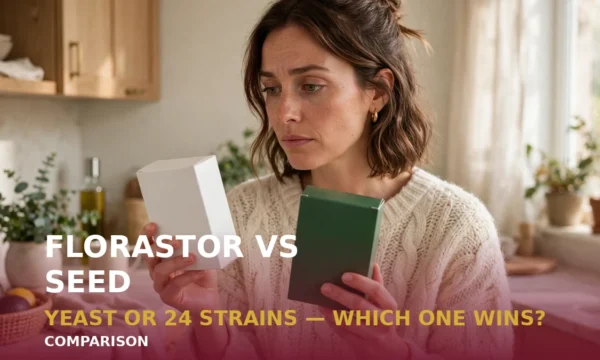
My aunt called me from the pharmacy aisle last Tuesday, antibiotics in one hand and her phone in the other. She held two boxes: Florastor and Seed. “Which one do I actually need?” she asked. If you have ever stood in that aisle, you are not alone. The honest answer to florastor vs seed is that these two are not really fighting the same fight.
Here is the short version. Florastor is one strain of a friendly yeast, for moments like antibiotics or travel abroad. Seed is a daily multi-strain bacterial synbiotic for everyday gut support. The mistake is buying one when your situation calls for the other, so this florastor vs seed comparison walks through seven honest checks.
Florastor vs Seed: the one difference that decides everything
The whole comparison turns on one fact: Florastor is a yeast, Seed is bacteria. Florastor’s only active ingredient is Saccharomyces boulardii CNCM I-745, a beneficial yeast from lychee fruit. Seed’s DS-01 is 24 bacterial strains plus a pomegranate prebiotic. Yeast and bacteria are different kingdoms of life, so they behave differently in your gut.
Antibiotics are designed to kill bacteria, so they cannot kill a yeast. That is why Florastor can be taken right alongside a course of antibiotics. Seed’s bacteria are exactly what antibiotics target. That is the first practical lesson of florastor vs seed. Our Florastor review covers its evidence strain by strain.
Check 1 — What is actually inside each capsule?
Florastor keeps things simple, and that is the first thing a florastor vs seed shopper should notice. One capsule holds 250 mg of S. boulardii CNCM I-745 at 5 billion CFU — the whole formula. No prebiotic, no second strain, no blend. You always know what you are getting, but you are getting exactly one thing.
Seed goes the opposite way. Each daily serving is two capsule-in-capsule ViaCap capsules holding 24 strains totalling 53.6 billion AFU, plus 400 mg of a pomegranate polyphenol prebiotic. The catch is that Seed reports its count in AFU, active fluorescent units, not CFU, so the two numbers cannot be lined up side by side. The label gives amounts per blend, not per strain.
Check 2 — What the research really supports
Florastor’s evidence is older and narrower, but strong for its one job. A 2015 meta-analysis of 21 trials with 4,780 people found that S. boulardii cut the risk of antibiotic-associated diarrhoea from 18.7% to 8.5%, a relative risk of 0.47, about one case prevented per ten treated. It also lowered the risk of traveller’s diarrhoea. You can read the paper on PubMed.
The Seed side of the florastor vs seed evidence question is newer and broader. The finished DS-01 product was tested in a six-week trial of 350 adults, and it beat placebo on bloating and regularity: 72.3% of the Seed group were rarely or never bloated, against 55.9% on placebo. The caveat is that Seed funded the trials, none tested people with diagnosed digestive disease, and the skin and heart claims rest on studies of individual strains.
Check 3 — Can you take it with antibiotics?
This is where the yeast-versus-bacteria difference stops being theory. Florastor was made for this moment: antibiotics do not touch yeast, so you can start it on day one of the prescription and keep taking it through the course. If antibiotics are why you are shopping, this check nearly settles it.
In a florastor vs seed decision made mid-prescription, Seed is better saved for after the antibiotics finish, to rebuild what the medicine cleared out. Taking it during the course is not harmful, but many of those bacteria will not survive, so you pay premium prices for microbes that never work. The NIH Office of Dietary Supplements agrees: effects are strain-specific.
Check 4 — Florastor vs Seed on price per day
Florastor costs roughly $25 to $38 a month depending on the retailer, or around 80 cents to $1.27 a day. Seed is $49.99 a month on subscription, about $1.67 a day. Over a year, the florastor vs seed gap is roughly $140 to $300 — real money for most households.
But cheaper is only better if it does the job you need. Florastor at under a dollar a day for a two-week antibiotic course is money well spent. Seed at $1.67 a day, every day, only makes sense if daily bloating is your actual problem. If price per day decides it for you, the same maths matters in our Thorne vs Nature Made comparison.
Check 5 — Side effects, and who should skip each one
For most healthy adults, both sides of florastor vs seed are well tolerated. Trial complaints were mostly mild: a bit of gas, some bloating in the first days, which usually settles. In Seed’s 350-person trial there were no serious adverse events, and side effects matched placebo.
Florastor carries one warning worth reading. As a live yeast, it has documented cases of reaching the bloodstream, a condition called fungemia, almost all in hospital patients with a central line or suppressed immunity. The maker says not to use it with a central line, a yeast allergy, or a severely weakened immune system. The capsules contain lactose and trace milk protein, and the capsule is gelatin, so vegans should skip it. If any of that applies, talk to your clinician first.
Check 6 — Storage, routine and the daily reality
Both are shelf-stable: neither needs the fridge, and both travel well. Florastor is one capsule, once or twice a day, with or without food. Seed is two capsules a day, and the subscription sends a box every month unless you pause it.
Day to day, florastor vs seed feels different. Florastor is a short-term guest: you buy it for a reason, use it for a couple of weeks, and then you stop. Seed asks to become a morning habit. Neither is wrong, but they ask different things of you, so be honest about which one you will stick with.
Check 7 — Florastor vs Seed: who should buy which?
Buy Florastor if you are starting antibiotics, travelling somewhere your stomach may not trust, or you want one well-studied strain for one clear job at a fair price. It is the specialist: narrow and proven. To see how Seed measures up against another single-strain rival, our Seed vs Culturelle comparison covers that pairing.
Buy Seed if your gut is already settled, everyday bloating is your main complaint, and you want a broad daily synbiotic with named strains and a finished-product trial. You pay for breadth and delivery, as a monthly commitment, not a one-off. Still comparing? Our Momentous vs Garden of Life and MaryRuth’s vs SmartyPants comparisons look at two different ways to spend the same money, and our Align vs Pendulum comparison covers the single-strain versus targeted choice.
There is no single winner, only a right tool for the job in front of you. If antibiotics or travel are in the picture, the choice tilts toward Florastor. If your days are normal and your gut needs steady support, it tilts toward Seed. Pick the one that matches your week, not the louder advert.
Frequently asked questions
In florastor vs seed, which one is better for daily use?
For everyday, long-term use, Seed is the better fit. It is built as a daily synbiotic with 24 strains and a prebiotic, and its finished-product trial looked at daily bloating over six weeks. Florastor is a specialist for short-term situations like antibiotics or travel, not an all-purpose daily formula.
If I am on antibiotics, does the florastor vs seed answer change?
Yes, completely. Antibiotics kill bacteria but not yeast, so Florastor can be taken alongside them and has the strongest evidence for that exact situation. Seed’s bacteria are vulnerable to antibiotics, so it is better saved for after the course, when the job is rebuilding.
Is the florastor vs seed price gap worth it?
It depends on the job. Florastor at roughly 80 cents to $1.27 a day is the better value for a short course during antibiotics. Seed at about $1.67 a day is a bigger commitment, and it is only worth it if you want broad daily support and will actually take it every day for months.
Is Florastor safe to take every day?
For most healthy adults, yes, it is generally well tolerated, and mild gas or bloating in the first days is the most common complaint. But it is not for everyone: skip it, or ask your clinician first, if you have a central venous line, a yeast allergy, or a severely weakened immune system.
Does Seed DS-01 need to be refrigerated?
No. Seed DS-01 is shelf-stable and does not need refrigeration, thanks to its capsule-in-capsule design. Keep it in a cool, dry place away from direct heat, and it travels well too.
Written by the HealthRovia editorial team. For general information only — not medical advice.