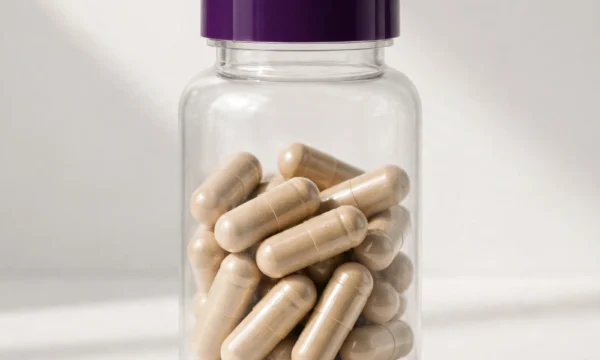
The Purple Cap You Have Seen for Decades
There is a bottle you may recognise before you read its label. A clear bottle, a deep purple cap, sitting in a Canadian pharmacy next to the bigger, louder brands. If you grew up in Canada, that purple cap probably sat in your parents’ medicine cabinet. If you are shopping from the United States and stumbled across the name online, you may be wondering whether this quiet Canadian brand is a hidden gem or just a local habit. You are not alone in this. The hardest supplement choices are not between a good brand and a bad one. They are between two decent brands that never explain themselves properly. This Webber Naturals review tries to do the explaining, honestly, including the parts the brand’s own shelf talk leaves out.
Webber Naturals is a Canadian-owned supplement brand that has been operating since 1948, headquartered in Coquitlam, British Columbia. The company formulates, manufactures and tests its products in British Columbia, grows many of its herbs and plants in the Okanagan Valley, and says every batch is tested to exceed quality standards for purity and potency. It is also a carbon-neutral company with a softgel waste management program built into its production. That is a genuinely unusual combination: a heritage brand, a short supply chain, and an environmental claim tied to how the factory runs rather than just a logo on the box. But heritage and good intentions are not the same as a great product in your hand, so let us look product by product.
What Webber Naturals Actually Sells
Webber Naturals is a broad everyday range, not a single hero product. Its best-known lines include a Most Complete Multi for men and women, melatonin in forms like a 3 mg quick-dissolve tablet and a 5 mg timed-release tablet, Coenzyme Q10 softgels including a 200 mg strength, probiotics such as an Acidophilus Bifidus formula with 6 billion colony-forming units, fish oil, vitamin D, magnesium, collagen, and herbal products like soy isoflavones. If Jamieson is Canada’s biggest shelf, Webber Naturals is the dependable neighbour on the same shelf: less famous internationally, more focused on pharmacy staples at everyday prices.
The first gap in most Webber Naturals coverage is blunt: there is very little independent review coverage to compete with. Search for this brand and you mostly find retailer product pages repeating the same company lines about 1948, British Columbia and the purple cap. When every page says the same thing, nobody has actually compared the melatonin dose, the probiotic strains, or the CoQ10 carrier oil. This review tries to do that work instead of repeating the brochure.
Melatonin: The Dose Question Nobody Asks
Webber Naturals melatonin is a good place to start, because it shows how a sensible brand can still confuse a shopper. The range includes a 3 mg tablet, a 5 mg timed-release tablet, and a 10 mg quick-dissolve tablet, and those are different tools, not a simple ladder where higher is better. Quick-dissolve suits falling asleep, while timed-release aims to keep you asleep through the night. Many buyers pick the highest number assuming stronger is better, and that is exactly backwards for melatonin, especially at 10 mg, which is a high dose. The research picture for melatonin is modest and honest: meta-analyses have found it can reduce the time it takes to fall asleep by roughly 5 to 22 minutes. That is useful, not miraculous, and it is not a cure for insomnia. Start low, take it well before bed rather than at midnight, and do not mix it with alcohol or other sleep aids. If sleep problems are new, persistent or worrying, a doctor’s visit comes before any supplement, not after.
The same dose discipline applies to CoQ10. Webber Naturals sells a 200 mg CoQ10 softgel, using rice bran oil as the carrier rather than cheaper soybean oil in many competitors, according to retailer product information. The studied daily range often discussed for CoQ10 is roughly 100 to 300 mg a day, so a single 200 mg softgel sits inside that range rather than at a fairy-dust dose. That is a point in the brand’s favour, and it is the kind of label detail that matters far more than the colour of the cap. But CoQ10 is not a medicine for heart disease, and no honest review should sell it as one. If you take blood thinners or heart medication, ask your doctor or pharmacist first, because supplements can interact with medicines.
Probiotics and the Billion-CFU Trap
Webber Naturals probiotics carry the same trap as every probiotic on the market: a big colony count on the front. The NIH Office of Dietary Supplements makes the key point plainly: a probiotic’s benefits depend on the specific strains it contains and the number of live organisms, and higher colony counts alone do not automatically mean greater benefit. A 6 billion CFU Acidophilus Bifidus product may be perfectly reasonable, but the number alone tells you almost nothing. What matters is which strains are listed, whether the count is guaranteed through the expiry date or only at manufacture, and whether the product needs refrigeration. Webber Naturals’ in-house British Columbia testing is a real advantage here, because probiotic counts fall over time, and a brand that controls its own factory has fewer excuses for a dead product. Still, judge the probiotic by its strain list, not its billions, and keep expectations modest: probiotics support gut balance, they do not rebuild it overnight.
The multivitamin story is similar. A one-per-day, non-GMO, vegetarian capsule multi is a sensible everyday format, and an easy-to-swallow capsule matters more than most reviews admit, because a vitamin you cannot swallow is a vitamin you will not take. But a multi fills gaps in an ordinary diet, it does not replace food, and the version matters: check iron content against your own needs, and remember that taking five Webber Naturals products at once is the most expensive way to find out which one helps. Start with one named gap, not a whole shelf. The same label-reading applies to the catalogue itself, which is genuinely confusing: many near-identical omega-3s, several vitamin D strengths, and a Collagen30 line in powder, gummy and tablet forms. Webber Naturals’ Triple Strength Omega-3 is the clearest anchor in that maze, at 600 mg EPA plus 300 mg DHA per enteric softgel, molecularly distilled, which is a solid label for the price.
One more honest note, because a review that hides a recall is not trustworthy. In July 2024, specific lots of certain Webber Naturals B-complex and 50+ multivitamins were recalled in Canada over possible metal fibres. That was lot-specific, not a brand-wide ban, and the advice was to stop using affected lots and return them to a pharmacy. If you own one of those products, check the lot number on your bottle against the Health Canada advisory. A single lot recall does not condemn a 75-year-old brand, but it does show why lot numbers exist.
Price, the Purple Cap, and the American Catch
In Canada, Webber Naturals is priced as an everyday pharmacy brand, often a little below the biggest names, and the purple cap really does function as a trust signal for shoppers who have bought it for decades. The carbon-neutral claim and the softgel waste program are genuine differentiators in an industry that rarely talks about its factory at all, though a careful reader should note that “carbon neutral” on a company page does not tell you exactly which emissions are covered. Treat it as a good sign, not a complete audit.
For American shoppers, the catch is sharper than with Jamieson. Webber Naturals is even less present in United States retail, so buying it from the US usually means an online order, sometimes an import, with shipping and price that erase the Canadian pharmacy value. Before paying that premium, compare it with a brand you can buy tonight: our Jamieson review covers the bigger Canadian rival, our Nordic Naturals review covers a fish-oil specialist, and our Lemme review covers a sleep-gummy alternative if melatonin gummies are more your style.
The Honest Verdict
Webber Naturals is worth buying when you are in Canada, you want a long-standing, British Columbia-made pharmacy brand at an everyday price, and you pick a specific product whose dose you have actually checked: a 3 mg melatonin to fall asleep, a 200 mg CoQ10, a clearly labelled probiotic. It is not worth importing at a premium from the United States when a local equivalent costs less, and it is not worth buying on heritage alone, because the purple cap tells you about the company’s history, not about the bottle in your hand. Check the strain, check the dose, check the label, and the brand will mostly reward that care.
For the head-to-head at the premium end, see our Momentous vs Thorne comparison, and for the other Canadian giant, our Jamieson review.
Frequently Asked Questions
Is Webber Naturals a good brand?
Webber Naturals is a reputable Canadian brand operating since 1948, with products formulated, manufactured and tested in British Columbia. Its everyday staples are solid, but judge each product on its dose and label rather than on heritage alone.
What does the purple cap mean?
The purple cap is Webber Naturals’ long-standing packaging signature in Canadian pharmacies. It signals the brand, not a quality certification, so it should not be treated as proof of what is inside the bottle.
Is Webber Naturals available in the United States?
It has very limited United States retail presence, so American shoppers usually buy it online, sometimes as an import. Compare the total landed price with a US pharmacy brand first.
Which Webber Naturals melatonin should I choose?
Quick-dissolve 3 mg suits falling asleep, while timed-release 5 mg aims to support sleep through the night. Start with the lower dose, take it well before bed, and see a doctor if sleep problems persist.
Are Webber Naturals probiotics effective?
Probiotic benefits depend on the specific strains and the live count through expiry, not on a big CFU number alone. Check the strain list and storage instructions, and keep expectations modest.
Is Webber Naturals really carbon neutral?
The company describes itself as carbon neutral with a softgel waste management program built into production. That is a genuine factory-level commitment, though company pages do not publish a full emissions audit, so treat it as a good sign rather than a complete verification.
For why probiotic benefits depend on strain and live count, see the NIH Office of Dietary Supplements probiotics fact sheet, and for EPA and DHA, the NIH Office of Dietary Supplements omega-3 fact sheet.
Written by the HealthRovia editorial team. For general information only — not medical advice.