If you’ve spent any time on sleep TikTok lately, you’ve met green noise. It promises ocean-wave calm, deeper sleep, sharper focus — all from a free sound on your phone. Millions of people have pressed play.
So here’s the question most articles about green noise won’t answer honestly: does it actually work?
We went to the peer-reviewed research — not the marketing — and the honest answer is more interesting than the hype. Here’s what green noise really is, what science can and can’t tell you, how it compares to the other noise colors, and the safe setup nobody else bothers to explain.
What Is Green Noise, Really?
Green noise is a sound that emphasizes mid-range frequencies. In plain language, it sounds like gentle ocean waves rolling in, a steady stream flowing over rocks, or soft, consistent rainfall. The bass is tamed, the hiss is softened, and what remains is a smooth, nature-like hum.
Here’s the first honest fact: green noise is not an official acoustic category. In acoustics, white and pink noise have precise mathematical definitions. Green noise has no such standard — it’s not defined in the US Federal Standard 1037C glossary, and different apps and websites define it differently. One site’s “green noise” might be another site’s “ocean waves track.” The term is closer to a marketing label than a scientific one.
That’s not necessarily a problem — it still sounds pleasant and can still mask disruptive sound. But it’s worth knowing before anyone sells you “scientifically optimized green noise” with exact Hz bands. Those bands are invented precision, not science.
Green Noise vs. White, Pink, and Brown Noise: A Clear Comparison
Every competitor article describes the “noise colors” in paragraphs. Here’s the comparison as a simple table.
| Noise color | Frequency emphasis | What it sounds like | Direct research on sleep | Best for |
|---|---|---|---|---|
| White noise | Equal energy across all frequencies | TV static, a loud fan, hissing | Most studied of the colors (still limited); Riedy 2021 review of 38 studies found evidence quality “very low” | Masking sudden sharp sounds (traffic, barking dogs) |
| Pink noise | Stronger at low frequencies, gentler highs | Moderate rainfall, rustling leaves | Some small studies suggest sleep benefits (Zhou 2012: brain activity synchronization); but a 2026 Penn study found ~50 dB pink noise cut REM sleep by ~19 minutes | Falling asleep faster — with the REM caveat below |
| Brown noise | Even deeper low-frequency emphasis | Deep rumbling, waterfall, thunder at a distance | Almost no direct sleep research | People who find white noise too harsh or hissy |
| Green noise | Mid-range frequencies emphasized | Ocean waves, a steady stream, soft rain | Zero peer-reviewed studies test green noise directly | A nature-like masking sound — if you find this particular texture pleasant |
The takeaway from the table: green noise’s selling point isn’t superior science. It’s texture. If mid-range, ocean-like sound relaxes you more than static does, that’s a perfectly good reason to choose it. Just don’t pay extra for “premium green noise” — the label isn’t standardized, and no study shows it outperforms the other colors.
What the Science Actually Says About Green Noise and Sleep
This is the section no competitor wrote honestly. Let’s be precise.
There are zero peer-reviewed studies that test green noise directly. Not one. Every benefit claim you’ve read about it is borrowed — extrapolated from research on white noise, pink noise, or nature sounds. When an article cites a study as green-noise evidence, check the fine print: it almost certainly tested something else.
Here’s what the borrowed evidence actually says:
The biggest review found the evidence “very low” quality. In 2021, researchers at the University of Pennsylvania’s Perelman School of Medicine (Riedy and colleagues) systematically reviewed 38 studies on continuous noise as a sleep aid. Their conclusion: the quality of evidence that continuous noise improves sleep was very low — which, they noted, contradicts its widespread use. They also warned that continuous noise “may negatively affect sleep and hearing.” That’s the strongest summary science has, and it applies to green noise just as much as to white noise.
The newest research raised a real concern. In early 2026, a Penn Medicine team led by sleep researcher Mathias Basner published a laboratory study in the journal Sleep that should be on every noise-machine user’s radar. Twenty-five healthy adults slept in a lab under different conditions: silence, aircraft noise, pink noise, and combinations. Pink noise played at about 50 decibels — roughly a moderate conversation — was linked to 19 fewer minutes of REM sleep per night compared to silence. Aircraft noise alone cut deep sleep by 23 minutes. The combination of both cut deep and REM sleep and added 15 minutes of wakefulness.
Why does this matter for green noise? Green noise is the same kind of continuous broadband sound the researchers studied. Basner’s conclusion was blunt: “Our results caution against the use of broadband noise, especially for newborns and toddlers.” He specifically called for more research on the different noise colors and on safe levels — which don’t exist yet.
Some smaller studies are more encouraging — in specific settings. Ebben and colleagues (2021) found white noise improved sleep for people living in high-noise New York City environments — the mechanism being masking: a steady sound blurs sudden, disruptive ones. Zhou and colleagues (2012) reported that pink noise improved synchronization of brain activity and sleep consolidation in a small study. And research on nature sounds (which green noise imitates) links them to general relaxation — though that’s about relaxation, not sleep architecture.
The popularity far outruns the proof. About 16% of Americans now use broadband noise at night, and streaming users log millions of hours of it daily. The market has raced ahead of the evidence — and the evidence’s newest chapter says to slow down.
So the honest verdict: green noise probably helps you fall asleep in a noisy environment by masking disruptions — that’s plausible and consistent with the masking research. Whether it improves your actual sleep quality (deep and REM sleep) is genuinely uncertain, and the latest study says it might do the opposite at common volumes. Anyone telling you otherwise is selling something.
Supplements are another popular option, but the evidence is mixed — our Relaxium Sleep review breaks down the ingredients and the fine print.
How to Use Green Noise Safely: The Setup Guide Nobody Gives You
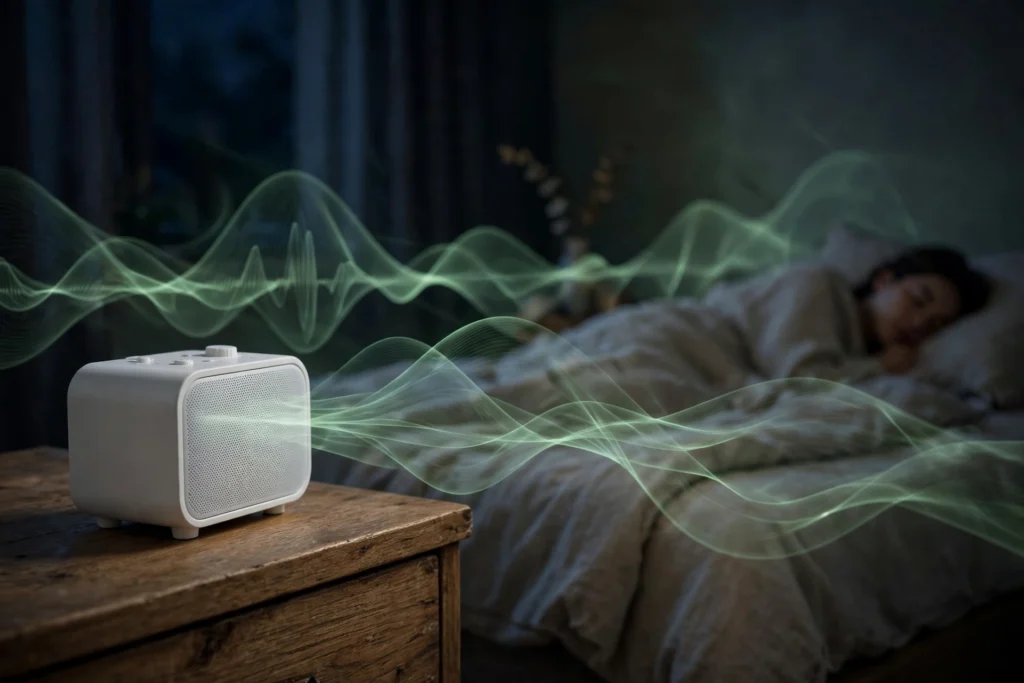
Keep it at or below 50 decibels at your pillow — about the level of a quiet conversation. The (WHO’s noise guidelines) recommend keeping nighttime noise below 45 decibels to avoid sleep disturbance — your sleep aid shouldn’t be louder than the noise you’re masking.
Put the speaker across the room, not on your nightstand. Sound intensity drops sharply with distance. Never sleep with earbuds playing noise all night — hours of direct sound exposure to your hearing.
Use a sleep timer. Once you’re asleep, there’s little reason to run noise all night. Most apps and speakers have auto-off timers; set yours for 30–60 minutes. This is especially important given the REM findings — you want masking while you drift off, not a continuous sound sculpting your sleep architecture all night.
Be extra careful with babies. Pediatric guidance (based on a 2014 study in Pediatrics) recommends: place the machine at least 7 feet from the crib, keep it at or below 50 decibels, set it as low as possible, and limit the duration — not all night. This matters doubly because newborns spend up to half their sleep in REM, the stage the Penn study found broadband noise disrupts. If your baby sleeps fine in quiet, quiet is the evidence-backed choice. For more on infant sleep aids, see our guide to (mouth tape for sleep) — and for the broader picture, (the science of better sleep) covers the 8 strategies with the strongest evidence behind them.
Don’t use it to drown out loud noise. If you’re cranking noise to cover construction, a snoring partner, or a TV next door, you’re just stacking sound on sound. Fix the source instead of adding decibels — earplugs are genuinely effective; the Penn study showed they protected deep sleep from aircraft noise.
Who Should Skip (or Limit) Green Noise
Honest guides include a “this isn’t for everyone” section. Here’s ours:
- People with tinnitus should not treat it as therapy. Sound can make ringing less noticeable (masking), which is real relief — but masking is not treatment, and constant masking can increase dependence on the sound. See an audiologist about evidence-based options.
- Anyone with hearing concerns. If you already have hearing loss or your ears ring after noise exposure, adding hours of nightly sound deserves a conversation with your doctor first.
- Parents of newborns and toddlers. The Penn team specifically cautioned against broadband noise for the very young, given how much REM sleep developing brains need.
- People who already sleep well in quiet. If silence works for you, the evidence gives you zero reason to add sound.
4 Myths About Green Noise, Corrected
Myth 1: “Green noise activates your rest-and-digest response.”
There is no direct evidence that green noise switches on your parasympathetic nervous system. If ocean sounds make you feel calm, that’s real — but it’s personal, not physiological fact.
Myth 2: “Green noise is scientifically defined at specific frequencies.”
Since the category isn’t standardized, numbers like “exactly 500 Hz” come from wherever the chart-maker drew them. Definitions vary by source — that’s the honest state of things.
Myth 3: “Green noise cures tinnitus.”
Masking a symptom is not curing a condition. No study shows green noise treats tinnitus.
Myth 4: “Green noise is proven better for sleep than white or pink noise.”
At least one competitor article claims green noise “masks background disturbances more effectively than white or pink noise.” No study has ever compared the noise colors head-to-head for sleep. The claim is fabricated.
Frequently Asked Questions
Is green noise good for sleep?
It may help you fall asleep faster in a noisy environment by masking disruptive sounds — that’s the most plausible benefit, consistent with research on white noise. But no study has tested green noise directly, and a 2026 Penn Medicine study found that continuous broadband noise at ~50 dB reduced REM sleep by about 19 minutes per night. Use it at low volume with a sleep timer, and don’t assume it’s improving your sleep quality.
What is the difference between green noise and white noise?
White noise spreads energy evenly across all frequencies and sounds like static or a loud fan. Green noise emphasizes mid-range frequencies and sounds more like ocean waves or steady rain. White noise has a precise technical definition; green noise does not — it’s a loosely used label for nature-like mid-spectrum sound.
Is green noise safe for babies?
Use it cautiously. Pediatric guidance recommends keeping infant sound machines at least 7 feet from the crib, at or below 50 decibels, and not running continuously all night. A 2026 sleep study specifically cautioned against broadband noise for newborns and toddlers, since young children spend much more of their sleep in REM — the stage most affected. If your baby sleeps fine in quiet, quiet is the safer choice.
What volume should green noise be for sleep?
Aim for 50 decibels or lower at your pillow — about the level of a quiet conversation. Place the speaker across the room rather than on your nightstand, and use a sleep timer so it switches off after 30–60 minutes instead of playing all night.
Can green noise help with tinnitus?
It may make ringing less noticeable by masking it, which some people find relieving. But masking is not treatment — no evidence shows green noise cures or improves tinnitus itself. If ringing persists, see an audiologist for evidence-based options rather than relying on nightly masking.
Written by the HealthRovia editorial team. For general information only — not medical advice.