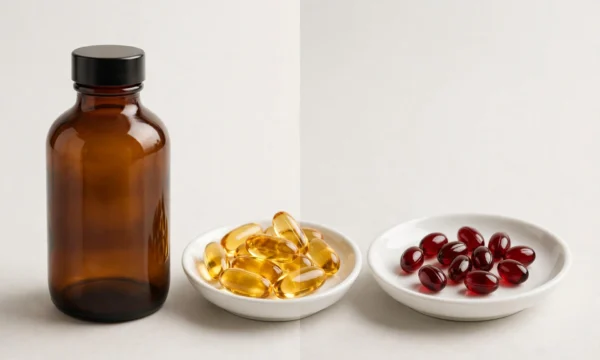
You know that moment in the supplement aisle — or three tabs deep into Amazon at 1 a.m. — staring at two bottles while your brain quietly panics? On the left, the big yellow jug of fish oil: cheap, familiar, the stuff your parents made you gag down as a kid. On the right, the smaller bottle with the dramatic red capsules: krill oil, twice the price, whispering about “phospholipids” and “superior absorption.”
Underneath is a quieter question: does any of it actually work? You’re not alone in this. Millions of us buy that red bottle with a mix of hope and guilt, usually thinking of someone we love — and hoping we’re doing something useful.
This week, that hope got a serious reality check. And oddly, it makes the fish oil vs krill oil question easier to answer honestly.
A brand-new 2-year study just humbled fish oil’s biggest claim
On October 23, 2026, USC researchers published in eBioMedicine a two-year, randomized, double-blind trial led by Dr. Hussein Naji Yassine: 365 adults aged 55–80, all without dementia but carrying at least one Alzheimer’s risk factor — nearly half carried the APOE4 gene. Half took 2,000 mg of purified DHA daily (the brain-active omega-3 in fish oil); half took a placebo.
The supplement worked biochemically: spinal-fluid DHA rose 17%, blood omega-3 index doubled from 4.9% to 11%. But over two full years: no difference in memory scores, no difference in hippocampal shrinkage. Dr. Yassine: “our findings showed that fish oil supplements do not appear to protect brain health.”
Precision note: the trial tested purified DHA capsules, not store-brand fish oil. It says nothing about EPA, whole fish oil, or krill oil — but it challenges the brain-protection marketing claim both oils lean on.
What each oil actually is (and what the label hides)
Fish oil delivers omega-3s mostly as triglycerides — the form your body stores fat in — or, in many concentrated products, as ethyl esters. A standard 1,000 mg softgel carries roughly 300–500 mg of combined EPA+DHA; concentrates pack in 500–900 mg. The big number on the bottle front is oil weight, not omega-3s.
Krill oil’s pitch: its omega-3s come 30–60% bound as phospholipids, plus free fatty acids. Sounds fancy. The catch: a typical 1,000 mg krill capsule delivers only about 100–240 mg of EPA+DHA. Real labels: one krill oil lists 136 mg EPA + 60 mg DHA per 1,000 mg capsule (plus 100 mcg astaxanthin); another lists 120 mg EPA + 80 mg DHA (plus 200 mcg astaxanthin). Five or six krill capsules match three standard fish oil softgels.
Krill’s phospholipids also bring a modest amount of choline — real, but not a reason to buy; two eggs give you more.
Absorption: the phospholipid hype, checked against real trials
Krill’s core claim — phospholipid omega-3s absorb “2 to 8 times better” — contains a grain of truth wrapped in exaggeration. The cleanest head-to-head (Yurko-Mauro, 2015): 66 adults took 1.3 g/day EPA+DHA for four weeks as krill oil, regular fish oil, or ethyl-ester fish oil. Blood EPA+DHA: 118 µg/mL for krill vs 108 µg/mL for standard fish oil. A 9% edge. Real — and nowhere near “2–8×.”
A 2025 network meta-analysis of 26 studies adds the boundary: krill’s phospholipid edge holds at oil doses below about 2,000 mg/day; above that, concentrated fish oil matches or exceeds it. The advantage is real but dose-bounded — it fades where serious doses live.
One older trial often cited for krill’s “superiority” only matched fish oil at nearly double the dose (3 g krill vs 1.8 g fish oil). Twice as much oil to tie — not superiority.
The price math nobody else shows you
Competitor sites never show the numbers, so let’s do it. Fish oil runs roughly $0.05–$0.15 per gram of EPA+DHA (concentrates: $0.08–$0.20). Krill runs roughly $0.50–$2.00 per gram, with one detailed cost analysis near $3 per gram. Krill costs about 3–10× more per gram of actual omega-3.
Concrete example — 1,000 mg of EPA+DHA a day:
- Fish oil: standard $10–$15 bottle (60 capsules, ~300 mg EPA+DHA each). Three to four capsules a day, ~18 days per bottle — roughly $20 a month.
- Krill oil: standard $30–$50 bottle (60 capsules, ~200 mg EPA+DHA each). Five capsules a day, ~12 days per bottle — roughly $100 a month.
A modest 9% absorption edge for about five times the money — and five capsules a day to hit the same dose. If you’re already buying premium supplement brands like Momentous, this price-per-gram math will feel familiar: krill charges a premium its absorption edge doesn’t justify at real doses.
Astaxanthin: a trace, not a treasure
Krill’s other selling point is astaxanthin, the red pigment in the capsules. Dose reality: a typical krill capsule carries 50–150 mcg (fortified products up to ~600 mcg per serving). Human clinical trials of astaxanthin use 4–6 mg a day — 10 to 100 times more. Its real job in the capsule is protecting the oil itself from oxidation. Useful preservative, not a therapy.
What the evidence actually supports (and the gap nobody mentions)
Krill’s brain-health marketing rests on thin evidence — short, small, sometimes industry-adjacent trials. Fish oil has the American Heart Association on record (~1 g/day EPA+DHA for heart-disease patients) and decades of research. No major guideline mentions krill oil.
The USC trial bounds both bottles: the brain-protection claim is challenged for high-dose DHA, and krill — less DHA per capsule, thinner clinical record — has even less standing to make it. And supplements aren’t eating fish: the oily-fish benefits in observational studies were never proven to transfer to capsules.
Omega-3s remain essential nutrients — your brain builds cell connections out of them. This corrects a marketing claim, not a nutrient. The researchers pointed to what actually moved the needle: about 3,800 steps a day and Mediterranean-style eating beat the capsule.
How to buy oil that isn’t already rancid
The number-one fish oil complaint isn’t price — it’s the fishy burps, often a rancidity signal. Buying fresh matters more than the fish-vs-krill debate.
- Read EPA+DHA total, never the front-label “oil mg.” “1,000 mg fish oil” can mean 300 mg of actual omega-3s. The supplement facts panel is the only honest label.
- Demand third-party oxidation testing. IFOS five-star certification or GOED compliance means peroxide values were actually measured. Brands like Thorne built their reputation on purity-tested fish oil — which is why third-party testing matters more than the phospholipid marketing debate.
- Do the smell test. Cut one open: sea smell is fine, dumpster smell means oxidized — toss it. Store cool, dark, sealed.
Krill has a modest edge — phospholipids and trace astaxanthin resist oxidation — but fresh, IFOS-certified fish oil beats stale krill oil every time. Same label-skepticism we recommend in our SmartyPants vitamins review: trust the certificate, not the front of the bottle.
The sustainability question nobody asks
Fish oil has its own issues — mercury is why you buy tested products — but krill’s ecological story is darker, and its sellers never tell it. Commercial krill fishing is banned in US waters; the whole supply comes from the Antarctic under CCAMLR. Krill populations have fallen roughly 80% since the 1970s, likely from warming, and krill is the base of the entire Antarctic food web. Whole Foods discontinued all krill products over a decade ago and recommends fish oil instead. A basic fish oil from a value brand — the kind in our Nature Made vitamins review — plus actual oily fish covers the essentials without touching the Antarctic food web.
Who should skip each oil
- Shellfish/crustacean allergy → no krill oil. Krill are crustaceans. Fish oil or algal oil instead.
- On blood thinners (e.g. warfarin) → ask your clinician first. Omega-3s can add to bleeding risk, especially at high doses. Applies to both oils.
- Respect the ceiling. The FDA caps combined EPA+DHA from supplements at 5 g/day. Side effects at normal doses are mild — more is not better. The NIH’s omega-3 fact sheet is the best plain-language reference for all of this.
The honest verdict
For almost everyone, fish oil wins. Three to ten times cheaper per gram of EPA+DHA, fewer capsules per dose, ~9,000 human studies to krill’s ~145, and the only oil any major guideline mentions. Its downsides — rancidity, burps, mercury — are solvable with certified, fresh product.
Krill’s honest niche is narrow: fish-oil burps you can’t tolerate, low maintenance doses (where its absorption edge holds), no problem paying five times more — or with the sustainability question. A real person, but not most people.
And the USC trial hangs over both bottles: buying either oil to protect against Alzheimer’s isn’t supported by the best available evidence. Eat the salmon. Take the walk.
FAQs
Is krill oil really more absorbable than fish oil?
Only modestly, and only at low doses. In a matched-dose human trial, krill raised blood EPA+DHA about 9% more than standard fish oil — not the “2–8×” marketing claims. A 2025 meta-analysis found krill’s phospholipid edge holds below roughly 2,000 mg of oil per day; above that, concentrated fish oil catches up or passes it.
How much omega-3 is actually in one krill oil capsule?
Far less than the big label number. A typical 1,000 mg krill capsule delivers about 100–240 mg of EPA+DHA (e.g. 136 mg EPA + 60 mg DHA), while a standard 1,000 mg fish oil softgel delivers 300–500 mg. Read the EPA+DHA total — never the front-label “oil mg.”
Is the astaxanthin in krill oil a real health benefit?
Not at supplement doses. A krill capsule carries roughly 50–150 mcg of astaxanthin; clinical trials use 4–6 mg a day — 10 to 100 times more. Its real job is protecting the oil itself from oxidation.
Which one is cheaper per gram of actual omega-3?
Fish oil, by a wide margin: roughly $0.05–$0.20 per gram of EPA+DHA vs roughly $0.50–$3.00 for krill — about 3–10× more expensive for the same active dose. Krill’s absorption edge doesn’t close that gap at meaningful doses.
Can I take krill oil if I’m allergic to shellfish?
No — krill are crustaceans. Fish oil or algal oil are the alternatives. Anyone on blood thinners should also talk to their doctor first, since omega-3s can add to bleeding risk.
Does either oil protect against Alzheimer’s or memory loss?
The best new evidence says don’t count on it. A 2-year, 365-person USC trial (published October 2026) gave high-dose DHA to older adults at Alzheimer’s risk — brain DHA rose 17%, but memory scores and hippocampal shrinkage matched placebo. Omega-3s remain essential nutrients, and eating fatty fish is still linked to better brain health — but the supplements aren’t proven prevention.
Written by the HealthRovia editorial team. For general information only — not medical advice.