
If you have scrolled through any health content in the last few years, you have met the celery juice craze: tall green glasses, solemn morning rituals, and a list of promises that reads like a miracle cure. So what are the real celery juice benefits — and which claims quietly fall apart when you look at the actual research? Here is the honest version. Celery juice is a low-calorie, hydrating drink with genuine nutrients in it. But no human study has shown that it cures autoimmune disease, flushes toxins, or replaces medical treatment — and some of the most-quoted “studies” turn out to be mouse experiments or concentrated leaf-extract capsules that have almost nothing to do with a glass of juice. Let’s sort the facts from the fiction, with real numbers and no hype.
What’s Actually in a Cup of Celery Juice
Before the claims, the nutrition label. According to USDA figures, one cup (about 236 ml) of celery juice contains roughly 33 calories, 7 grams of carbohydrates — only 3 grams of which are natural sugars — and just 189 mg of sodium, about 8% of the daily value. Compare that to apple juice, which packs around 24 grams of sugar per cup, and celery juice suddenly looks like one of the lightest drink options in the produce aisle.
Whole celery also brings about 4 grams of fiber per cup, though juicing removes most of it (more on that below). You also get meaningful amounts of vitamins A, C, and K, folate, and potassium, plus plant antioxidants. One detail worth knowing: reviewers like GoodRx have pointed out that celery’s antioxidant compounds are most abundant in the leaves, not the pale stalks — so those leafy tops you usually toss are arguably the most nutritious part of the bunch.
Bottom line: as a beverage, celery juice is mostly water with a light sprinkle of vitamins. That’s genuinely good. It’s just not a medicine.
Celery Juice Benefits: Claims vs. What the Science Says
This is where things get interesting. The internet credits celery juice with fixing almost everything. Below is a claim-by-claim breakdown — what is said, and what the evidence actually supports.
| Claim | What the evidence says |
|---|---|
| Cures autoimmune disease or can replace chemotherapy | No evidence. No human study supports this, and skipping real treatment for juice is dangerous. |
| “Detoxes” heavy metals and toxins from the body | No evidence. Your liver and kidneys handle detoxification; no study shows celery juice speeds that up. |
| Heals eczema, psoriasis, acne, or migraines | No evidence. These claims come from wellness books, not clinical research. |
| Lowers blood sugar | Weak and indirect. One small study used concentrated leaf-extract capsules, not juice — details below. |
| Calms the gut and fixes digestion | Unproven. No clinical trials on celery juice and digestive disorders. |
| Hydrates and supplies light nutrition | Supported. It is mostly water with real vitamins and minerals. |
Now let’s look study by study, because the devil is in the details:
The blood-sugar study everyone quotes. The most-cited piece of real research is a 2018 trial by Yusni and colleagues, published in the Saudi Medical Journal. Sixteen elderly pre-diabetics over age 60 took 250 mg capsules of concentrated celery leaf extract three times a day, 30 minutes before meals, for 12 days. Pre-meal blood glucose fell by 9.8% and post-meal glucose by 19.5% compared with placebo — statistically significant. But insulin levels did not change significantly, and the sample was tiny. Most importantly: this was a concentrated extract capsule, not a glass of juice. You cannot pour 250 mg of ethanol-extracted leaf concentrate from your juicer. Interesting as early science; useless as proof that morning juice lowers your blood sugar. (Yusni et al., Saudi Med J 2018)
The mouse study. Another frequently shared “finding” comes from an experiment in mice — and it used fermented celery juice, a completely different product from the fresh juice in your glass. Animal results often don’t translate to humans, and fermented juice isn’t fresh juice. File this one under “not applicable.”
The claims with literally nothing behind them. For the autoimmune, cancer, chemo-replacement, and migraine claims, there is no human evidence at all — not small studies, not weak studies, none. GoodRx’s medical reviewers reached the same conclusion: there is no evidence that celery juice alone improves health conditions. When a wellness influencer says “studies show,” ask which studies. Usually, there are none.
So what can you honestly say about celery juice benefits? It hydrates you, it delivers vitamins A, C, and K with very few calories, and it is a far better choice than sugary juices or sodas. Those are real benefits — modest, unglamorous, and true.
Celery Juice vs. Whole Celery: Is Juicing Actually Better?
Here is a question the juice gurus rarely ask: is drinking celery better than just eating celery? Probably not. A cup of chopped celery carries about 4 grams of fiber, which slows digestion, feeds gut bacteria, and keeps you full. Juicing strips most of that fiber away, leaving you with the water, some vitamins, and faster-absorbing natural sugars.
Chewing also matters. It takes time and effort, which gives your brain a chance to register fullness — one reason whole fruit consistently beats fruit juice in nutrition research. If you love the ritual of a morning glass, enjoy it. But if your goal is nutrition per stalk, eating the celery (leaves included) wins on fiber and satisfaction, for zero extra work. For a broader look at how fluids fit into your day, our guide to how much water you actually need breaks down the hydration math.
Two Numbers Worth Knowing: Sodium and Vitamin K
Sodium: 189 mg per cup. That is about 8% of the daily value, which is modest for most people. But “modest” adds up if you are on a salt-restricted diet for blood pressure or kidney reasons, or if you drink several large glasses a day. Context matters: it is still far less sodium than most processed drinks, but it is not zero, and the celery-juice-every-morning crowd rarely mentions it.
Vitamin K and blood thinners. Celery is a meaningful source of vitamin K, which helps your blood clot normally. That becomes important if you take anticoagulant (blood-thinning) medication such as warfarin: sudden big changes in vitamin K intake can interfere with how the drug works. MedlinePlus advises people on blood thinners to be careful about how much vitamin K they get and to check with their health care provider about diet changes (MedlinePlus: Vitamin K). A daily large glass of celery juice is exactly the kind of new habit worth mentioning to your doctor or pharmacist. The same caution applies if you take other medications affected by vitamin K — when in doubt, ask.
How to Make Celery Juice the Right Way
If you are going to drink it, make it count:
- Use the whole bunch, leaves and all. The leaves carry the highest concentration of antioxidants, and they add flavor. Just trim any wilted bits.
- Wash thoroughly. Celery ribs trap grit in their grooves; rinse each stalk under running water.
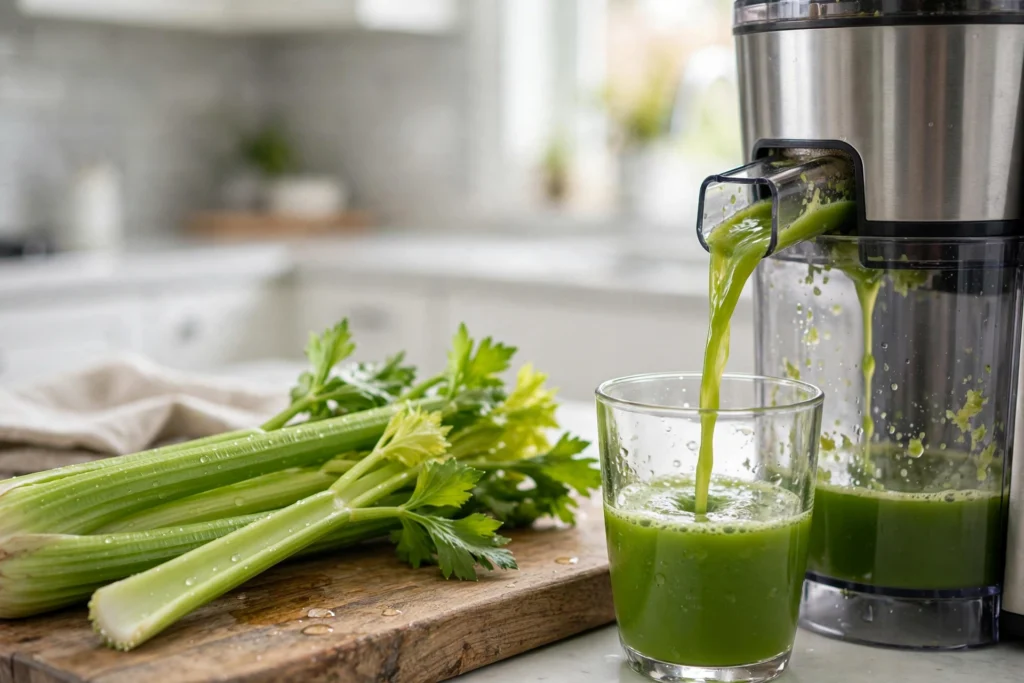
- One large bunch makes roughly one cup. Chop, juice or blend, and strain through cheesecloth if you blended.
- Drink it fresh. Juice oxidizes quickly; aim to drink within 24 hours and keep it refrigerated.
- Keep expectations honest. A squeeze of lemon makes it taste better. It does not make it a cure for anything.
Celery juice also pairs well with an overall nutrient-dense diet — see our roundup of superfoods that support your immune system for easy additions that carry stronger evidence behind them.
Frequently Asked Questions
Does celery juice detox your body? No. There is no human evidence that celery juice removes toxins or heavy metals. Your liver and kidneys handle detoxification around the clock, and no juice has been shown to speed that process up.
Can celery juice cure autoimmune disease or replace medical treatment? No. There is zero clinical evidence behind these claims. Never stop or replace prescribed treatment with juice or any other food — that decision belongs between you and your doctor.
Is celery juice better than eating whole celery? Not nutritionally. Whole celery keeps about 4 grams of fiber per cup, which juicing removes. Reviewers have found no evidence that celery juice alone improves health conditions beyond what the vegetable itself offers.
Is celery juice high in sodium? Moderately. One cup has about 189 mg of sodium — roughly 8% of the daily value. Fine for most people, but worth counting if you follow a salt-restricted diet or drink large amounts daily.
Can I drink celery juice while on blood thinners? Talk to your doctor first. Celery contains vitamin K, which affects how anticoagulant medications like warfarin work. MedlinePlus advises anyone on blood thinners to keep vitamin K intake consistent and get medical guidance before making big dietary changes.
Written by the HealthRovia editorial team. For general information only — not medical advice.