It is 7 in the morning, and the kitchen counter tells the whole story. On the left sits the shaker bottle and a tub of green powder, the scoop hiding at the bottom as usual. On the right sits a small daily pack of gummies, torn open by the coffee mug. The real question is not which greens product is better in some abstract sense. It is which one you will still reach for in week three, when the novelty has worn off.
Two very different answers to the same morning
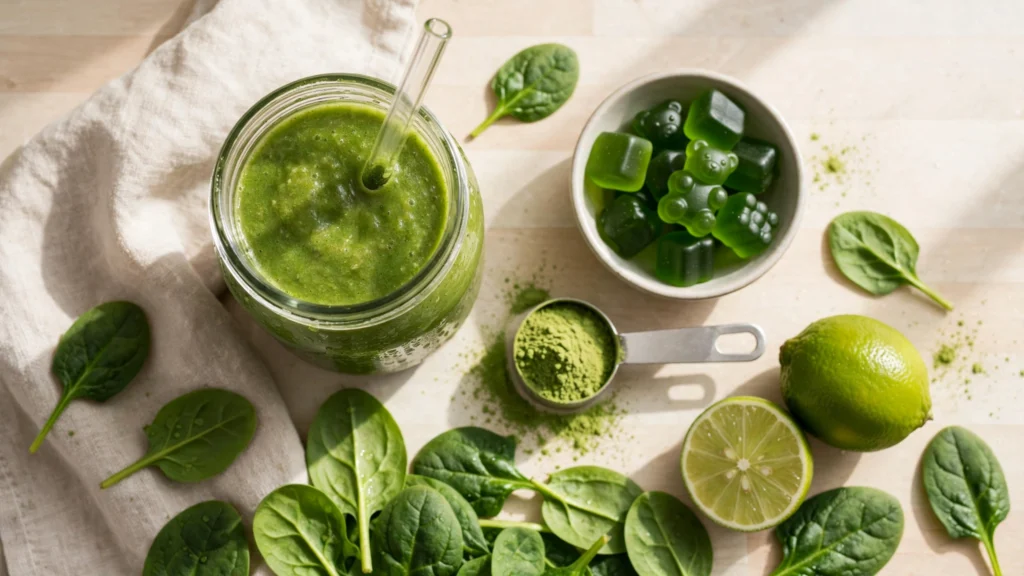
Bloom Greens & Superfoods is a powder. One scoop goes into about eight ounces of water. A 30-serving tub sells for around $39.99, about $1.33 a serving. Inside are 30-plus ingredients across several blends: greens, fruit and antioxidant ingredients, fiber, digestive enzymes, and a pre and probiotic blend, plus adaptogens. It comes in flavours like Citrus, Berry and Mango, and it is light — around 15 calories a serving, about 2 grams of fiber, and essentially no added sugar. Our Bloom Greens review walks through the powder in detail.
Grüns is a different animal entirely: a daily greens gummy, eight gummies per day in a single-serving pack. The formula lists 60-plus ingredients, including 21 vitamins and minerals with stated doses, 6 grams of prebiotic fiber, and whole fruits and vegetables, super mushrooms, prebiotics, adaptogens and antioxidants. A pack has 50 calories and 8 grams of added sugar in the low-sugar version. The list price is $79.99 for a 28-day supply, about $2.85 a day, with first-time subscriptions offered from around $29.99. Our Grüns Gummies review covers the gummies on their own terms. Neither is a meal replacement, and neither replaces eating actual vegetables.
The label, side by side
The two labels handle transparency very differently. Grüns names its 60-plus ingredients and lists the doses of its 21 vitamins and minerals, so you can see you are getting 100% of the daily value for vitamin C and vitamin D3. That matters, because the NIH Office of Dietary Supplements puts the recommended daily amount at 75 mg for adult women and 90 mg for adult men.
Bloom organises its 30-plus ingredients into seven proprietary blends. You can see the total weight of each blend, but not how much of any single ingredient inside it you are getting. The label also lists no vitamins or minerals on its supplement facts panel, so you cannot confirm from the label alone whether you are getting meaningful amounts of vitamin C, vitamin A or iron.
On fiber, Grüns is ahead: 6 grams of prebiotic fiber per serving against Bloom’s roughly 2 grams. On sugar and calories, Bloom wins — essentially sugar-free at about 15 calories per serving, against 8 grams of added sugar and 50 calories for Grüns. On minerals, Grüns lists iron, zinc and vitamin D3, but no calcium or magnesium; Bloom’s label verifies none.
The blend problem neither side fully escapes
Bloom’s seven proprietary blends are the bigger problem, because they cover almost the whole formula — you know the ingredients are in there, but not how much of each. When a blend weighs a few grams and holds a dozen ingredients, some may be present in amounts too small to matter. Grüns is more open, but not perfectly open either: its botanical ingredients are still grouped without individual doses. The honest claim is “more transparent than Bloom,” not “fully transparent.”
The money math, without the marketing
Here the price gap is hard to ignore. Bloom at about $1.33 a day costs roughly $40 a month and about $480 a year. Grüns at list price costs about $2.85 a day, roughly $80 a month, and over $1,000 a year. That is more than double. Subscription pricing narrows the gap — first-time subscriptions have been offered from around $29.99 — but Grüns stays the more expensive habit, and introductory prices do not last forever.
What does the extra money buy? Named vitamin and mineral doses, more fiber, and a broader ingredient list. If you already take a multivitamin, much of what Grüns adds may duplicate something you already have. If you take nothing else, Grüns covers more ground in one product — Bloom plus a separate multivitamin would cost about as much anyway.
Taste, and the habit you will actually keep
Here is the part no label can settle, and it is the part that decides most real-world outcomes. A greens product only works if you take it every day for months, and that is a habit question, not a chemistry question. Both brands are huge on TikTok — Bloom is one of the strongest TikTok performers among supplement brands, and Grüns has sold more than 47,000 units on TikTok Shop — but popularity is not proof a product works for you.
Bloom wins on flavour variety and on drinking something that tastes like a light fruit drink rather than a health chore. The trade-off is the ritual: scoop, water, shake, wash the shaker. On a travel day, it is a small production, and small productions are exactly what busy mornings kill first.
Grüns wins on pure convenience. You tear open a pack and chew eight gummies. No water, no shaker, no washing up, no measuring. The taste is fruity and sweet, closer to a treat than a supplement — easy to take, which is the whole point, but the 8 grams of added sugar in the low-sugar version is the price of that ease. If you dislike gummy textures, that advantage disappears fast.
Probiotics, adaptogens, and what the evidence actually says
Both products talk about gut health, energy and stress support. Probiotics and prebiotic fiber can support digestion, and Grüns’ 6 grams of prebiotic fiber is a meaningful amount — but Bloom does not disclose the colony-forming units of its probiotic blend, so you cannot verify the dose. Grüns has one piece of evidence Bloom does not: a 2025 randomised, double-blind, placebo-controlled study that measured nutrient levels in participants’ blood. That is stronger evidence than most greens brands can point to, but not proof they will change how you feel. Supplements are regulated as food, not drugs, and as the FDA explains, they are not approved for treating disease — talk to a health care professional before starting one.
The lawsuit and the billion-dollar deal
Two pieces of news about Grüns deserve a straight answer. First, the acquisition: Unilever acquired Grüns in 2026 in a deal widely reported at around $1.2 billion. That is a business story, not a health claim.
Second, the lawsuit: in July 2026, a label-accuracy lawsuit claimed independent testing found 5.27 grams of fiber per serving, against the 6 grams claimed on the label. That is a claim in a lawsuit, not a verdict — it has not been decided in court. The gap, if proven, would be real but modest — under a gram — and one disputed number in a filing is not a finding that a product is unsafe or ineffective.
Who should pick which
There is no single winner here. Pick Bloom if budget matters most, if you want a light, sugar-free drink you can flavour to your taste, or if you already take a multivitamin and just want a greens top-up. At about $1.33 a day, it is the easiest greens habit to start and keep paying for. Its label weakness is real, but it matters less if you are not relying on Bloom as your main source of micronutrients. See also our Celsius energy drink review, Alani Nu energy drink review and LMNT electrolytes review.
Pick Grüns if you want one product to cover the most ground, if you travel a lot or hate washing shakers, or if you struggle to stick with powders and know a gummy is the format you will finish. At about $2.85 a day at list price, it is a premium habit — only worth it if you are using what it covers, the vitamins, the minerals, the fiber, rather than duplicating a multivitamin you already take. See also our Celsius vs Ghost Energy comparison.
Still torn? Buy the smaller size of each, take each for two weeks, and notice which one you reach for without thinking — the best greens supplement is the one that becomes a habit.
Frequently asked questions
Is Bloom or Grüns better overall?
It depends on what you value most. Grüns wins on transparency, vitamin and mineral coverage, and fiber, with 60-plus named ingredients and a 2025 clinical study. Bloom wins on price — about $1.33 a day versus about $2.85 for Grüns — and it is sugar-free and lower in calories. If you already take a multivitamin, pick Bloom.
Is Bloom Greens worth it?
For many people, yes, at its price. At about $1.33 a serving, Bloom is one of the cheapest ways to add a greens powder to your morning. The limitation is transparency: its seven proprietary blends hide individual doses, and the label lists no vitamins or minerals, so you cannot verify nutrient amounts from the label alone. It is a light top-up, not a main source of vitamins and minerals.
Are Grüns gummies worth the price?
They can be, if you use what you are paying for. At $79.99 for 28 days, about $2.85 a day, Grüns is more than twice the price of Bloom, but it lists 60-plus ingredients with 21 named vitamins and minerals and 6 grams of prebiotic fiber. If it replaces a multivitamin and a greens powder, the cost looks much more reasonable.
Do Grüns gummies have sugar?
Yes, the low-sugar version has 8 grams of added sugar per daily serving of eight gummies, along with 50 calories. There is also a sugar-free version if you want to avoid the sugar entirely. Bloom, by comparison, is essentially sugar-free at about 15 calories a serving, so if sugar is your main concern, Bloom or the sugar-free Grüns are the options to choose between.
Which is better for gut health, Bloom or Grüns?
Grüns has the stronger case on paper, with 6 grams of prebiotic fiber per serving against Bloom’s roughly 2 grams, and doses you can check. Bloom focuses on digestive support too, but it does not disclose the probiotic dose on its label, so the claim is harder to verify. Neither product is a treatment for digestive problems.
Does Bloom or Grüns have more ingredients?
Grüns lists more: 60-plus ingredients, including 21 vitamins and minerals with stated doses. Bloom lists 30-plus ingredients across seven proprietary blends, without individual doses or listed vitamins and minerals. More ingredients is not automatically better — what matters is whether the amounts are meaningful, and that is where Grüns’ named doses give it an edge.
Written by the HealthRovia editorial team. For general information only — not medical advice.