
It was past ten at night, and I had two browser tabs open. One showed a small glass jar for $49.99 a month. The other showed a familiar pharmacy bottle for about half that. If you have ever weighed a pretty jar against a plain bottle, you are not alone in this. That moment is why this comparison of seed probiotics and Garden of Life exists, and why I will show you the maths first.
Seed Probiotics vs Garden of Life: The Short Answer
Garden of Life Dr. Formulated Probiotics Once Daily is the better buy for most people. You get 50 billion CFU and 15 to 16 strains, in one shelf-stable capsule a day, for roughly $30 to $40 a month. Seed DS-01 names all 24 strains, groups them into four blends, and uses a capsule-in-capsule design with a pomegranate prebiotic. It costs $49.99 a month, on subscription. Is that extra detail worth about $10 to $20 more a month? For many people, the honest answer is no.
The Price Math Most Reviews Skip
A daily habit only works if you can keep paying for it. Here is the maths, using prices checked on 11 November 2026.
| What you pay for | Seed DS-01 | Garden of Life Once Daily |
|---|---|---|
| Price, 30 days | $49.99 | About $30 to $40 |
| Cost per day | About $1.67 | About $1.00 to $1.33 |
| Cost over a year | About $600 | About $360 to $480 |
| Live count per day | 53.6 billion AFU | 50 billion CFU |
| Cost per billion, per month | About $0.93 | About $0.60 to $0.80 |
AFU and CFU are not the same unit, so the last row is a rough guide, not a laboratory comparison. Garden of Life wins the maths clearly. Seed asks you to pay roughly 25 to 55 percent more per billion for its strain naming, its prebiotic, and its delivery design. The same thinking applies to any daily habit, which is why people who compare routines look at the full cost first, as in our Huel vs Soylent comparison, before they fall for the packaging.
AFU vs CFU, in Plain Words
CFU means colony-forming units, the traditional count: how many live bacteria can grow into colonies in a lab dish. Garden of Life uses CFU, like most brands in a shop. AFU means active fluorescent units. Seed counts its bacteria with flow cytometry, using fluorescent light to count intact cells, including cells that might not grow in a dish.
Neither unit is automatically better. AFU can give a fuller count, but it is not directly comparable to CFU, so 53.6 billion AFU does not beat 50 billion CFU the way a bigger number usually wins. The NIH says the strain and dose studied matter more than the headline count. Read that in the NIH Office of Dietary Supplements probiotics fact sheet, and the same warning in the National Center for Complementary and Integrative Health guide to probiotics. That is the first honest test for seed probiotics: if a brand leans on a big number and says little about its strains, the number is doing the selling, not the science.
What Seed Probiotics Actually Give You for $50
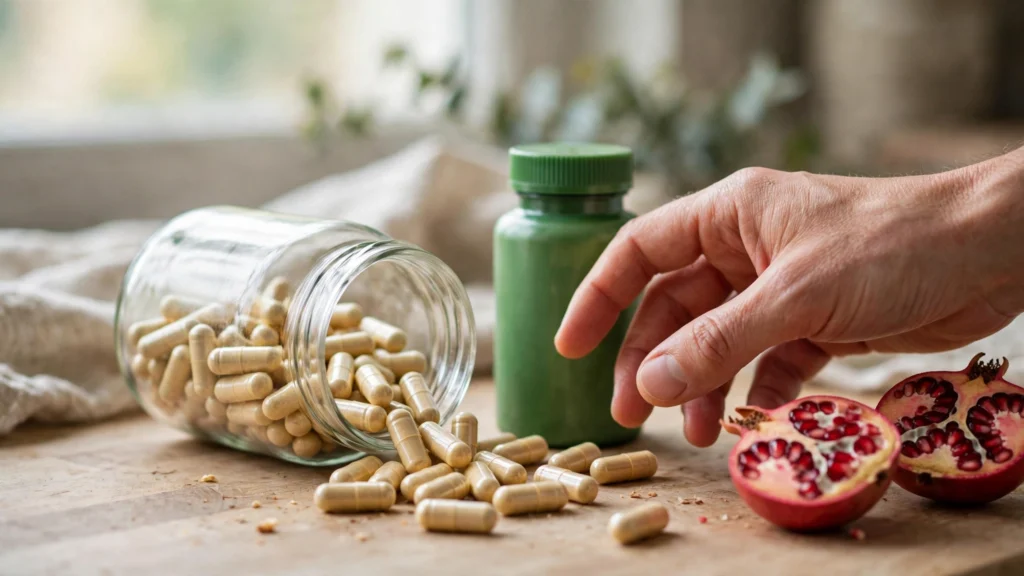
Seed DS-01 is a synbiotic, combining probiotics with a prebiotic in one product. The prebiotic is a pomegranate-derived compound called MAPP, made from Indian pomegranate, in the outer capsule. Inside is a second, smaller capsule holding the 24 probiotic strains. The idea is that the outer capsule protects the inner one through stomach acid so more bacteria reach the colon.
Seed groups its 24 strains into four blends, and names every strain with its strain code, the letters and numbers that pin down the exact culture.
| Seed blend | Strains | Live count | Named examples |
|---|---|---|---|
| Digestive health | 16 | 38.7 billion AFU | B. longum SD-BB536-JP, L. plantarum SD-LP1-IT, L. rhamnosus SD-GG-BE |
| Micronutrient synthesis | 2 | 7.32 billion AFU | B. adolescentis SD-BA5-IT, L. reuteri SD-LRE2-IT |
| Dermatological health | 4 | 3.34 billion AFU | L. salivarius SD-LS1-IT, B. lactis SD-CECT8145-SP |
| Cardiovascular health | 2 | 4.21 billion AFU | L. plantarum SD-LPLDL-UK, B. lactis SD-MB2409-IT |
The digestive blend carries most of the weight, at 38.7 billion AFU, while the skin and heart blends are much smaller. It is third-party tested for allergens, heavy metals, pesticides and contaminants, according to Seed, although Seed does not publicly name its testing laboratory.
What Garden of Life Gives You for Less
Garden of Life Dr. Formulated Probiotics Once Daily is a simpler idea, done well. One vegetarian capsule a day, shelf-stable, no fridge, with an organic prebiotic fibre blend made from potato resistant starch and acacia fibre.
| Formula | Live count | Strains | Largest strains by dose |
|---|---|---|---|
| Once Daily Women’s | 50 billion CFU | 16 | L. plantarum Lp-115, 22 billion; L. acidophilus La-14, 11 billion; B. lactis Bl-04, 6.7 billion |
| Once Daily Men’s | 50 billion CFU | 15 | B. lactis Bl-04, 16 billion; L. acidophilus La-14, 15 billion; L. casei Lc-11, 7 billion |
A handful of strains carry most of the dose. The bigger difference is transparency. On the US product pages, Garden of Life names species and highlights a few strains, but it is less granular than Seed about matching every strain to a clinical trial. Where Garden of Life is stronger is certification. It is a B Corp, its Dr. Formulated line is Non-GMO Project Verified, and it is NSF Certified Gluten Free.
The Evidence, Without the Hype
Seed has put more effort into published research on its own formula than Garden of Life has published for its exact Once Daily blend. A randomised, double-blind, placebo-controlled trial of DS-01 in 350 healthy adults with self-reported bloating or indigestion was reported in early 2026 in the journal Nutrients. The trial was funded by Seed and run by Radicle Science, an independent research organisation.
The honest reading is modest. The trial supported DS-01 for digestive and quality-of-life measures, and other write-ups describe the effects as incremental rather than dramatic: some improvement in bloating and regularity for some people, not a transformation. If your gut trouble is tied to a specific, named issue, a single-strain product with a trial behind that exact strain can be a smarter first step. Our Culturelle review looks at that narrower approach, and it is worth reading before you spend $50 a month on a broad formula.
Who Should NOT Pay $50
Do not pay $50 a month for Seed DS-01 if you just want a dependable daily capsule and you are not chasing a specific strain. Garden of Life Once Daily gives you a comparable live count, the same shelf-stability, and a lower price, and the difference in everyday results is likely to be small. Do not pay it if you hope it will fix a diagnosed gut condition, clear up a skin condition, or replace medical care, because neither product is a treatment. And do not pay it if money is tight. A $600-a-year habit that adds stress works against the calm, regular routine your gut needs. In the end, seed probiotics are a premium choice, not a default one, worth considering only if you specifically want the 24 named strains, the pomegranate prebiotic, and the capsule-in-capsule delivery, and the extra cost does not bother you. Talk to a clinician first if you are pregnant, immunocompromised, seriously ill, or managing a gut condition.
Subscription, Glass Jar and the Refill Reality
Buying Seed is not like buying Garden of Life. Garden of Life you can pick up once, from a shop or online, and walk away. Seed is sold mainly by subscription through its own site, at $49.99 a month after the first month, with 25 percent off the first month in the offer shown at the time of writing. Your first order comes in a reusable glass jar, with later orders as refills. You can pause or cancel at any time.
How to Choose in 60 Seconds
First, what is your actual goal? If it is general daily gut comfort, pick Garden of Life and give it six to eight weeks. Second, does a specific strain matter to you, because a clinician mentioned it or because you have read a trial on it? If yes, check whether Seed names that strain. Third, can you afford $600 a year without thinking about it? If that number makes you wince, you have your answer.
It is easy to forget that. If your days are built around skipped meals, a shake or a protein routine may be the more useful comparison first, which is why readers often pair a gut-health decision with our Soylent review or our Myprotein vs Optimum Nutrition comparison. If you are comparing powders that also promise gut support, our Grüns vs AG1 comparison and our Optimum Nutrition Gold Standard Whey review ask the same value question from the protein and greens side.
Questions People Actually Ask
Is Seed DS-01 worth $50 a month?
For most people, probably not. Garden of Life gives you a comparable live count and shelf-stability for about $30 to $40 a month. Seed is worth it mainly if you specifically want its 24 named strains, its pomegranate prebiotic, and its capsule-in-capsule delivery.
Does more strains or a higher count mean a better probiotic?
No, not on its own. The NIH says probiotic effects are strain-specific, and higher CFU counts alone do not necessarily mean greater benefits. What matters is whether the exact strain was studied, at what dose, for what purpose.
What is the difference between AFU and CFU?
CFU counts bacteria that can grow into colonies in a lab dish. AFU counts intact cells using fluorescent light, including cells that might not grow in a dish. They are measured differently, so 53.6 billion AFU and 50 billion CFU are not a direct, like-for-like comparison.
Do Seed DS-01 or Garden of Life Once Daily need refrigeration?
No. Both are shelf-stable and need no refrigeration, which makes either one easy to store at home or take when you travel.
Can I buy Seed DS-01 without a subscription?
Seed sells DS-01 mainly by subscription through its own site, at $49.99 a month after the first month, with pause or cancel at any time. Check the current buying options and price before you commit, since both can change.
Which probiotic is better for bloating?
Neither product is proven as a treatment for bloating, and results vary a lot from person to person. Seed has a trial in healthy adults that showed modest digestive improvements, while Garden of Life relies on familiar strains rather than a trial of its exact blend. If bloating is persistent or painful, talk to a clinician instead of trying bottle after bottle.
Written by the HealthRovia editorial team. For general information only — not medical advice.